Stakeholder tracking in urban transformation projects: a CRM guide for developers
How do you track stakeholders in urban transformation? The difference from a regular customer, consent tracking, CRM structure, and communication automation.
Under the regulation that took effect in 2026, urban transformation decisions in Turkey can now be made with a simple majority calculated by land share (just over half), rather than the previous two-thirds majority of owners. This change speeds up the process, but it also brings a different challenge for developers: you now need to work with more stakeholders, across more buildings, in a shorter timeframe — and at that scale, tracking who has consented and who is still deciding through spreadsheets stops being practical.
An important detail: this majority calculation is based not on the number of stakeholders, but on each stakeholder's actual land share percentage. That means two different buildings with the same number of stakeholders can follow completely different dynamics when it comes to reaching the required majority — a small number of stakeholders holding a large land share can secure the simple majority on their own. This nuance means your CRM needs to hold not just "consented / not consented," but each stakeholder's actual share as well.
In this guide, we'll cover why a stakeholder needs to be treated differently from a regular customer, the specific challenges in stakeholder tracking, how to structure this process in a CRM, and how to make communication systematic. (Note: this piece offers a general framework; always consult a legal advisor for current regulations and your specific process.)
How is a stakeholder different from a regular customer?
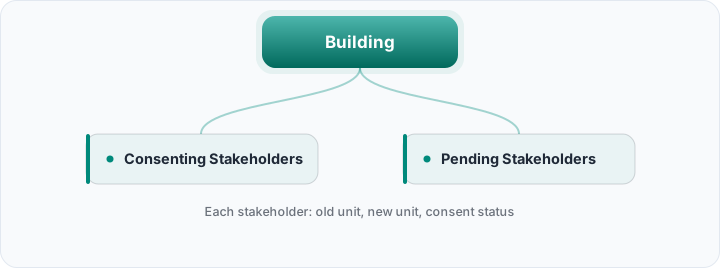
In a standard real estate sale, the customer hands over money and buys a new property — the relationship is one-directional. In urban transformation, a stakeholder already owns a property (their unit in the old building) and trades that property for a unit in the new building; usually there's also an additional payment involved (or a share of revenue, in a "revenue-sharing" model). This is a far more complex relationship than a sale: the stakeholder's old unit, their new unit allocation, any additional payment or credit, the temporary housing/rent support process, and — most importantly — whether they've consented to the project, all need to be tracked as a single, interconnected record.
The specific challenges in stakeholder tracking
A building can have dozens of stakeholders, each carrying a different concern — one worries "will my new unit be smaller," another asks "where will I stay during construction." That diversity is too broad to manage with a single standard message. On top of that, the consent process is spread out over time — some stakeholders sign right away, while others may remain undecided for weeks; knowing in real time who has consented and who is still pending during that in-between period is a critical need for both the developer and the project team.
How should you structure a stakeholder record in your CRM?
A healthy structure keeps the following information in a single record for every stakeholder: old unit details (unit number, square footage, land share percentage), new unit allocation (which new unit they correspond to), consent status (consented / pending / objected), financial status (is additional payment required, how much, on what timeline), and communication history (who was contacted when, what concerns were raised). Keeping this information interconnected in a single system, rather than scattered across files, is the foundation for both project management and the transparency you'll need to show in any potential dispute.
Why does consent tracking matter so much?
The simple-majority rule is a system where the decision is calculated based on land share percentage — meaning you need to know each stakeholder's actual share, not just their headcount. Being able to see those shares and each stakeholder's current consent status on one screen in a CRM lets you track in real time how close you are to the required majority. Seeing pending stakeholders in a separate list also helps you direct your communication effort correctly — instead of sending everyone the same general message, you can run a focused follow-up on those who haven't decided yet.
Communication automation with stakeholders
Communicating one by one, manually, with dozens of stakeholders takes time and carries a risk of inconsistency. Using ready-made message templates for standard updates (a construction milestone, a meeting invitation, a payment reminder) both saves time and guarantees every stakeholder receives the same correct information at the same time. What's critical is that this automation doesn't give up on personalization — when a stakeholder has a specific question, that question should reach a response tailored to them, not a generic template.
Manage your stakeholder process in your CRM
Rocketly's Construction CRM module keeps every stakeholder's consent status, old-to-new unit match, and communication history in one record.
See the Construction ModuleWhy do meeting and decision records matter separately?
Decisions made during an urban transformation process concern not just the stakeholders, but also the developer in the event of a legal review or dispute. Keeping notes in your CRM about which meeting was held when, which decision was made on what date, with how many participants — this isn't just an operational convenience, it's a record that ensures the process's transparency and its retroactive provability when needed. When these notes are tied to the stakeholder record, you can answer "which meeting was this decision made in, and in front of whom" within minutes.
How should the temporary housing/rent support process be tracked?
While a building is demolished and rebuilt, most stakeholders need to stay somewhere else during that period — in some cases, rent support is provided by the government or as part of the project. Tracking who receives this support, how much, and for what period is a natural extension of the stakeholder record; when this information sits in a separate system, you can't instantly answer even a simple question like "has this stakeholder been paid their rent support." As construction timelines stretch (which happens often in urban transformation projects), keeping this tracking current becomes increasingly critical.
A concrete scenario: how does the process work in a 20-unit building?
Picture a 20-unit building with equally distributed land shares. Reaching the required majority takes roughly 11 stakeholders' consent. Once the process starts, each stakeholder's status is tracked separately in a CRM record: 7 consent immediately, 5 are convinced after a meeting, 3 remain undecided, and 5 have additional questions. The project team sees, on a dashboard showing consent status, "we need 11, we're currently at 12" in real time — following logic similar to visually tracking unit status in a stacking plan, here stakeholder consent status is tracked on a visual dashboard too. That visibility makes it clear exactly which 3 people the team needs to spend extra time with.
How does proactive transparency strengthen trust?
In a sensitive, long-running process like urban transformation, a stakeholder's biggest concern usually comes from the feeling of "not knowing where things stand." Sharing a short update with all stakeholders at regular intervals (say, monthly) — "we're currently at this stage, this many have consented, here's the next step" — reduces uncertainty even before anyone asks. This kind of proactive reporting habit makes not just pending stakeholders, but also those who've already consented, feel connected to and informed about the process — one of the most effective ways to preserve patience over a long construction timeline.
Common mistakes
- Treating stakeholders like regular customers: a standard sales CRM flow doesn't meet a stakeholder's specific needs, like old unit/new unit/consent status.
- Not keeping consent status current: a delay in processing a stakeholder's consent can lead to miscalculating how close you actually are to the required majority.
- Running communication through a single channel: communicating only through meetings without keeping a digital record leaves "who was informed and who wasn't" unclear.
- Keeping financial details in a separate system: having additional payment or revenue-share information in a separate spreadsheet, disconnected from the CRM, prevents seeing the full picture from one place.
A starting checklist for developers
- 1. Create a single record for every stakeholder. Old unit, new unit, land share, and consent status should all live in the same record.
- 2. Update consent status regularly. Know at all times how close you are to the required majority.
- 3. Track pending stakeholders in a separate list. Focus your communication effort on this group.
- 4. Prepare templates for standard communication. But don't neglect giving personal answers to personal questions.
- 5. Get expert support for the legal process. A CRM organizes the process, but you'll need a legal advisor for regulatory compliance.
Frequently asked questions
Do I need separate software for stakeholder tracking?
No — an existing construction CRM system, configured with the right fields (old unit, new unit, land share, consent status), can meet this need. What matters most is keeping this information interconnected in a single system rather than scattered across files.
How should communication with non-consenting stakeholders be handled?
This is a sensitive topic intertwined with the legal process — your CRM should transparently log communication history and status, and be able to clearly answer "who was contacted, and when" in any potential dispute. Always work with a lawyer for the legal dimension of this process.
What changes if multiple buildings/projects are managed at once?
As scale grows, tracking things one by one stops being practical. Being able to see the consent status, stakeholder count, and communication load of multiple projects from a single dashboard makes it easier to determine which project needs priority attention.
How different is this timeline from a normal sales process?
The consent-gathering process can follow a longer and more uncertain timeline than a normal sale — some stakeholders decide right away, while others may take weeks. The way to manage that uncertainty isn't to rush the process, but to track every stage transparently.
The urban transformation process requires far more stakeholders, far more sensitivity, and far more tracking detail than a standard sales process. Structuring that complexity correctly in a CRM isn't just an operational convenience — it's the foundation for offering a transparent, traceable process to both your stakeholders and any potential audit.