Monthly vs annual billing: which to offer
Monthly or annual? We compare the billing period across cash flow, churn, discounts and commitment, and show when to offer each, and when to offer both.
Every subscription business hits the same fork while setting up its pricing page: one product, two buttons. One says "monthly," the other says "annual." Which one do you put forward, which one gets the discount, and which one becomes the default? The monthly vs annual billing question looks like a small toggle, but it quietly moves your cash flow, your churn, and your margin all at once.
This article will not sell you a single "right answer," because there isn't one. Instead we will look at the four levers underneath the decision, cash flow, churn, discounts, and commitment, and then get specific about when to offer monthly, when to offer annual, and when to offer both.
What you are actually trading
Billing frequency is not a price question; it is a balancing question. Whether you collect twelve months up front or spread the same amount across the year, that one choice pulls on four things at the same time.
Seeing them separately helps, because most businesses look at just one, usually the discount, decide, and then discover the other three later.
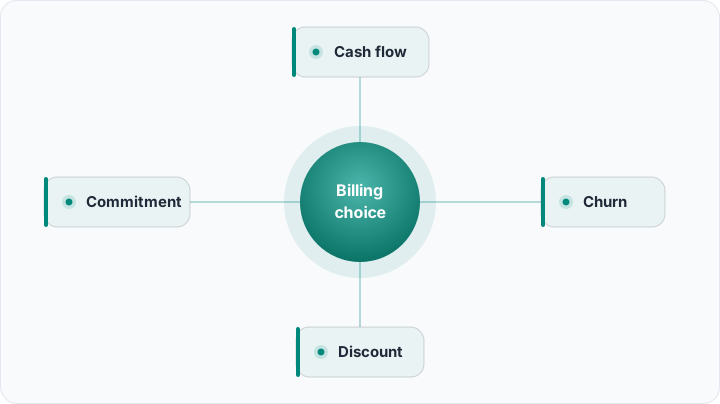
- Cash flow: An annual plan puts money on the table today; a monthly plan divides the same amount across twelve payments.
- Churn: On monthly, a customer can leave every month; on annual, any loss is deferred to renewal day.
- Discount: Making annual attractive almost always costs a discount, margin you agree to give up.
- Commitment: A customer who pays up front leans into the product; a customer pushed in before they are convinced leans out.
Cash flow: the real pull of annual
For a small business, an annual payment is often oxygen. Picture a two-person online fitness studio. When a hundred members pay for the year at once, that money lands as one lump: you can film new content, hire a coach, open an ad budget. If those same hundred members paid monthly, you would gather the same total in thin slices over twelve months.
Cash up front lets you fund growth from your own customers instead of a loan. That is the honest appeal of annual, and a big one for a business without deep pockets. Where costs keep rising, money collected today is worth more than money collected next year.
But there is a quiet trap. The money you collect annually is payment for twelve months of service; it is not all first-month profit. Spend it in the first quarter and fail to deliver for the rest of the year, and it comes back as refunds and complaints. Treat annual cash as revenue stretched across the year, not a windfall to burn.
Churn: monthly shows it, annual hides it
On a monthly plan, churn is live and continuous. Every month somebody clicks cancel, painful, but an honest signal. You see what is not working early, while you can still fix it.
Annual billing mutes that signal. A customer who is unhappy in month four still cannot leave; your loss stays invisible until the renewal date. That does not lower churn; it defers it and stacks it onto a single day.
Here is the danger: an annual plan can mask a weak product for a full year. The customer who would have left in month three on monthly instead stays twelve months and simply does not renew. You got the cash, but the underlying dissatisfaction is unchanged. Annual buys you time; if you do not spend that time fixing the product and the onboarding, the problem just presents its bill on renewal day.
So the number to watch on annual is not the cancel rate but the renewal rate. Building a subscription business around renewals is its own discipline, and we cover it in depth in CRM for subscription and renewal sales.
The discount: what commitment costs you
Nobody pays a year up front as a favour. They expect something back, usually a discount, the familiar "two months free" gesture. That discount is really a trade: in exchange for cash today and a longer commitment, you hand over a slice of your margin.
The question is whether the discount is worth the cash and retention it buys. Too small a discount moves nobody onto annual. Too generous a discount loses money on customers who would have stayed anyway, and it can make annual so cheap that the monthly plan stops making sense.
A practical balance: frame the discount not as a gift but as a fair deal where both sides win. How you present the price and the saving directly shapes the acceptance rate; our pieces on quote management and objection handling walk through the real question hiding behind "it's too expensive."
Commitment cuts both ways
A customer who pays up front invests in the product psychologically as well as financially. They use the tool they paid for, embed it deeper into their team, and look at alternatives less. That is the best side effect of an annual plan.
But the same commitment can backfire. Push someone into a yearly contract before they are convinced and you manufacture buyer's remorse, refund requests, and one-star reviews. The feeling of being "locked in" can cost more than no sale at all.
An annual plan is a reward for the convinced customer and a trap for the unconvinced one.
Don't leave renewals to chance
Rocketly tracks monthly and annual subscribers on one screen and sends renewal and payment reminders automatically.
Try Rocketly freeWhen to offer monthly, when annual, and when both
A simple rule: sell unproven value monthly and proven value annually. If the customer does not trust your product yet, asking for a small "yes" is the smarter move.
Lead with monthly when:
- The product is new or slow to prove its value: Customers want to try with low risk, and a monthly plan opens that door.
- The purchase is large and cautious: Asking for a high-ticket commitment up front scares off most of the people who were curious.
- You cannot carry heavy refund exposure: Twelve months of prepaid cash is also twelve months of refund liability if the fit is uncertain.
Lead with annual when:
- The product is sticky and the value is obvious: If the customer is going to stay anyway, reward them with a discount and pull the cash forward.
- You need the cash flow: When you want to fund growth from prepaid revenue, annual earns its keep.
- The relationship is mature: A customer who has been happy for a few months is at the moment most open to committing for a year.
For most businesses the honest answer is "both." You land on monthly, prove the value, then move the customer to annual. This "land, then expand" approach keeps the door wide and still gathers the cash over time.

When you do offer both, show annual as the default and highlight the saving, but keep the monthly door open. The strongest moment is renewal: telling a happy monthly customer "switch to annual and get two months" converts far better than making the same offer to a cold prospect. You can build that switch as a stage in your sales pipeline and catch happy customers at exactly the right time; moving them up is itself a close, which our guide to sales closing techniques can help you run.
Three common mistakes
- Making annual the only option: An annual-only model before the product is proven dries up the top of the funnel.
- Spending annual cash right away: With twelve months of service still owed, burning the money in month one leaves you exposed to any refund wave.
- Forgetting the renewal: Assuming an annual customer "stays automatically" is the most expensive assumption of all; a renewal takes as much care as the first sale.
Frequently asked questions
How big should the annual discount be?
There is no magic number. Think of the discount as payment for the cash you collect early and the longer commitment you gain. Don't make it so generous that the monthly plan stops making sense, and don't make it so thin that nobody moves. A common starting point is a discount that feels like "a month or two free."
Can I just offer annual only?
You can, but only if your product is proven and the price is not too high. For a new or expensive product, an annual-only model loses most of the prospects who simply wanted to try before committing.
How do I move monthly subscribers to annual?
The best moment is when the customer is happy, after they have seen the first value, or as renewal approaches. A clear offer like "switch to annual and get two months" at the right time lifts conversion sharply.
Does annual billing really reduce churn?
It reduces visible cancellations, because the customer cannot leave mid-term. But the real test is the renewal rate. Annual buys you time to fix a poor experience; it does not fix it on its own.
There is no single answer to monthly versus annual; it depends on how mature your business is, how badly you need cash, and how quickly your product proves its worth. For most, the healthy path is to enter on monthly and offer annual as a reward once trust exists. Whichever model you pick, the thing that matters is follow-through: knowing who is on monthly, who is on annual, and who is approaching renewal. When a CRM like Rocketly gathers subscribers and renewal dates on one screen and automates the reminders, the billing period stops being a guessing game and becomes a process you can actually run.