Storytelling in sales: make the pitch memorable
A feature list slides off; a story sticks. A practical guide to storytelling in sales: the shape of a sales story, turning a dry number into a scene, and where it helps.
Ask a salesperson what makes their product good and most will reach for a list: the features, the specs, the price, the warranty. It sounds thorough. The trouble is that a buyer forgets a list of features almost as fast as they hear it, while a story about someone just like them can stick for days. That gap is where storytelling in sales earns its keep — not as a performance, but as a way to make the value land and stay landed.
This is a practical look at how a small business can turn a flat feature list into a narrative that pulls the buyer in: what a sales story is, the shape most good ones share, how to turn a dry number into a scene, and where a story helps as well as where it gets in the way.
Why a feature list slides right off
Picture a two-person real-estate office pitching a landlord on managing a rental. One agent runs through the list: professional photos, three listing portals, tenant screening, a solid contract, monthly reports. All true, all useful, and all forgotten by the time the landlord reaches the car.
The other agent tells a short story instead. A landlord on the same street had a flat sitting empty for two months, quietly losing rent, until they re-shot the photos, corrected the price, and signed a screened tenant in nine days. Same capabilities, now wrapped around a person and a problem. Which version does the landlord repeat at dinner that night?
People store information as narrative. A specification answers "what is it?"; a story answers "what happens to someone like me?" — the question a buyer is quietly asking the whole time, in the language memory already uses.
What storytelling in sales actually means
It helps to clear up what this is not. Storytelling in sales is not spinning fairy tales, and certainly not dressing up a weak product with drama. If the product does not deliver, a polished story only speeds up the disappointment. Honesty is not the opposite of a good narrative; it is the ingredient that makes one hold.
What it really means is plain: instead of listing what you do, you show it inside a real situation, with a real person at the center. The facts do not change — the frame does. A pre-accounting feature stops being a bullet point and becomes the Sunday evening a shop owner finally stopped typing invoices at the kitchen table.
A feature tells a buyer what your product is. A story tells them who they get to become.
The shape of a sales story
Most stories that work in a sales conversation share a plain four-part shape, and you do not need to be a writer to use it. The one decision that matters most is who plays the hero — and it is never you.

The character is a customer as close as possible to the person in front of you: same trade, similar size, the same headache. The tension is the real problem they lived with, described honestly enough that your listener winces in recognition. The turning point is where your product quietly enters, not with fanfare but as the thing that changed things. The result is where they landed, told in concrete terms rather than adjectives.
Notice the order. Weak sales stories open with the product and bolt a problem on afterward. Strong ones start with the person and the pain, so that by the time the solution appears the listener wants it to. It is the same backbone behind any sales pitch that actually wins: situation first, product second.
Turning a number into a scene
This is where most feature lists go to die, and where the real skill lives. A number on its own — "saves you three hours a week," "response within 24 hours," "cuts data entry in half" — is easy to say and easy to doubt; buyers have heard them all. What they have not heard is what that number looks like on an ordinary Tuesday in a business like theirs.
So walk the number into a scene. Instead of "our maintenance plan guarantees a 24-hour response," an HVAC company might say: a small restaurant's walk-in freezer died on a Friday evening, with a weekend of bookings and a full stock of fish inside; a technician arrived before closing, and nothing was lost. The guarantee is identical, but now it has a smell and a stake.
A quick way to build these: name the feature, translate it into the benefit, then drop the benefit into a specific moment. "Automatic invoice reminders" becomes "you stop chasing late payers," which becomes "the furniture-maker who used to lose Sunday nights to overdue invoices now chases none, because the reminders send themselves." Keep the numbers honest: if you do not know the exact figure, say "a couple of hours" rather than inventing one. An invented statistic is the fastest way to lose the trust the story was meant to build.
Where a story helps across the sale
A story is not a single set-piece you deliver once. Small, well-placed stories do quiet work at every stage of the sales funnel, and the version you reach for shifts with the moment.
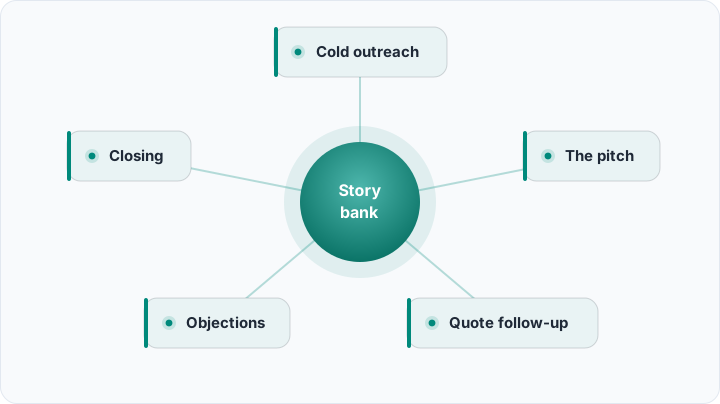
At the very top, a story is a way in. A cold call that opens with "we help companies like yours" gets hung up on; one that opens with a ten-second, recognizable situation earns another thirty seconds. If cold outreach is part of your week, it pays to build that opener deliberately, the same way you would a cold-call script that gets responses.
Later, stories do their heaviest lifting against objections and at the close. When a buyer says "it's too expensive," a story about a customer who thought the same and later found the cheaper option cost them more beats arguing about price — which is really what good objection handling comes down to. And a short reminder of where a similar customer ended up is often the gentlest of the closing techniques: it lets the buyer picture the finish line without being pushed toward it.
Build a small story bank
The salesperson who tells great stories rarely improvises them. They keep a handful of real ones, sanded smooth by repetition, ready for the moment they fit. The difference is not talent; it is that they kept the stories somewhere instead of losing them.
This is worth being systematic about. Every won deal is a story waiting to be recorded: who the customer was, the problem they came in with, what nearly stopped them, and where they ended up. Jot it down while it is fresh, tag it by industry or objection, and you slowly build a library you can pull from by situation rather than memory. A follow-up message that carries a two-line mini-story of a similar customer is one of the quiet reasons some reps have a better quote follow-up and win rate than others.
Keep your best stories where you can find them
Rocketly stores every conversation, won deal, and customer note in one place, so the story that closes your next sale is never lost in someone's memory.
See how it worksWhen a story gets in the way
Storytelling is a tool, not a religion, and forcing it has costs. A few honest cautions are worth more than another technique.
- Making yourself the hero. If every story ends with how clever your company was, the buyer feels sold to. Keep the customer in the lead role and let your product stay the helpful guide.
- Talking too long. A sales story is thirty to sixty seconds, not a monologue. The moment the buyer's eyes drift, you have turned a tool into an indulgence.
- Inventing the details. A story that did not happen is a lie with better lighting. Use real customers, blur their names if you must, but never fabricate the facts or the figures.
- Reading the room wrong. Some buyers, at some moments, just want the price and the delivery date. Tell a story then and you are the obstacle, not the guide.
The honest summary is that a story is worth telling when it helps the buyer see themselves, and worth skipping when it only helps you perform. That judgment call is the actual craft.
Frequently asked questions
Isn't storytelling just manipulation?
It becomes manipulation only when the story is false or hides a real flaw. A true story about a real customer simply helps a buyer understand the value in terms they recognize; the facts are unchanged, only the framing is clearer.
What if your product is boring or very technical?
Boring products often have the best stories, because the pain they remove is usually specific and dull in a way buyers feel keenly. Skip the mechanism and describe the ordinary moment it fixes: the missed invoice, the lost weekend, the frozen freezer.
How long should a sales story be?
In a live conversation, thirty to sixty seconds. Long enough to set a character, a problem, and a result; short enough that the buyer never wonders where it is going. In writing, two or three sentences is often plenty.
How many stories do you actually need?
Fewer than you would think. A working set of five or six, one per common customer type or objection, covers most conversations. Collect them from real won deals rather than trying to invent a library up front.
Storytelling in sales is not about being a natural performer or spinning something out of nothing. It is the discipline of putting a real customer, a real problem, and a real result where a feature list used to be, and knowing when to do it and when to stop. Start by writing down the next deal you win while the details are fresh; that single habit will outperform any script. Tools help — a system like Rocketly that keeps every conversation and closed deal in one place means your best stories are always within reach — but the story itself, honest and well aimed, is still the part that does the selling.