Sales proposal template and winning structure
The sections a winning sales proposal needs, plus a ready-to-fill skeleton with square-bracket placeholders.
Most proposals aren't lost on price. The buyer opens the document and finds two lines of greeting and a single grand total — or the opposite, a ten-slide deck with the answer buried inside. Both are missing the same thing: the clarity it takes to say yes. A good sales proposal template fills that gap, so instead of a blank page every time, you begin knowing which sections a winning document is built from.
This guide takes a proposal apart section by section: which parts are non-negotiable, what each is for, and how to order them. At the end there's a ready-to-fill skeleton with square-bracket [placeholders] — just drop in your business, sector and price.
What a proposal actually does
A proposal is not a price list; it is a decision document. Often the person reading it isn't even the person you spoke to — a partner, an accountant, a spouse weighing the choice at the kitchen table. So it has to stand on its own, carrying the context, the scope and the price without you in the room.
It helps to treat a proposal not as a one-off file but as a structure you reuse. Build it as part of a quote process that leaves nothing to chance, and every new customer gets the same quality. The document changes; the skeleton stays.
The sections a winning proposal needs
Most winning proposals share the same skeleton. The order shifts a little by industry, but these sections are almost always present:
- Cover and header: Who it's for, what it's about, the date. "[Customer] proposal for [outcome]" lands in the first second; a blank "Proposal" title doesn't.
- Their situation: The customer's problem, in their own words. It says "I listened," and earns the reading of everything after.
- Proposed solution: What you'll do, in plain language, tied to their goal.
- Scope: What is included and what is not. Most disputes grow out of a missing scope section.
- Timeline: When the work starts and finishes, with a few milestones.
- Price: The number and what it covers; a couple of options where they help.
- Terms and next step: A validity date, payment terms, and the single clear action to take.
The order carries a message too: open with the customer's world, not your company; put the price in the middle, once context is set; close on one next step.

Open with their problem, not your company
The most common mistake is opening with "Founded in 2012, our company..." The buyer is scanning for their own problem, not your history. If the first paragraph sums up their situation, they read the rest thinking "this is for me."
Picture a small interior-design office quoting a café refit. Opening with "reworking a kitchen that can't keep up with the evening rush, so the room seats 45 within two weeks" beats "we have completed 40 projects" — the same job, two very different proposals.
This section is the written form of a sales pitch: the story you tell out loud, compressed into one paragraph. It needn't be long — two or three sentences usually do it.
Scope: the real work is in "what's excluded"
The scope section is the most skipped and most useful part of a proposal. Listing what's included is easy; the value is in stating plainly what is not.
- Included: The concrete things you'll deliver — countable phrases like "three revisions," "a five-page site," "delivery and installation included."
- Excluded: The commonly requested work that isn't in the price. Naming it isn't rude — it's the courtesy that heads off the later "I thought that was included" argument.
A clear scope protects you after you win the job, too. When extra requests arrive, there's no quarrel — you point to something written before you say, "that was out of scope; let me quote it separately."
Present the price so yes is easy
Price is the most-read and worst-presented part of a proposal. Rather than pinning one huge number to the bottom of the page, show it beside what it buys — the buyer is approving a value, not a figure.
- Break out the lines: Instead of one "total," show the main items so the buyer sees what they pay for and why.
- Two or three options where they help: Small, medium, full. Don't overdo it; five packages don't ease the decision, they delay it.
- Restate what's included: A short "what's inside" line by the price settles half the negotiation up front.
If you're selling something recurring, like maintenance or a subscription, whether you bill monthly or annually is part of the proposal too; putting both side by side often speeds the decision. For a simple one-off job, a plain price quote beats a full proposal — not every job needs the long form.
Terms and a single next step
A proposal that says what will be done, then leaves the reader hanging, is only half finished. Put three things at the end: a validity date, a payment term, and one action to take.
The validity date creates polite urgency — "this price holds until [date]" pulls the decision forward without pressure. The payment term prevents surprises: deposit, instalments, tax in or out. The next step should be single and clear: sign, reply "approved," or send a deposit. Put two asks side by side, and most people do neither.
What happens after the document lands matters too. Rather than sending and waiting, planning your quote follow-up visibly changes the win rate, and a few well-timed closing techniques can carry a hesitant buyer over the line.
An example proposal skeleton (ready to fill in)
The skeleton below is a starting point, not a mould. Fill in the brackets with your own work and delete any line that doesn't fit. One page is plenty for a small service job; each heading can expand for a big project.
Cover
Proposal from [Your company] for [Customer] · Date: [date] · Valid until: [date] · Prepared by: [name, phone/WhatsApp]
1. Your situation, in brief
In our conversation you mentioned the goal of [customer's goal] and the obstacle of [specific problem]. This proposal is built to solve exactly that.
2. What we propose
[What you'll do, in one sentence]. Concretely: [step 1], [step 2], [step 3].
3. Scope
Included: [item 1], [item 2], [item 3]. Excluded: [out-of-scope work] — quoted separately on request.
4. Timeline
Start [date], first delivery [date], completion [date].
5. Price
[Package/item]: [amount] (includes: [short list]). Optional [alternative]: [amount]. Prices are [tax included/excluded].
6. Terms
Payment: [X% up front, balance on delivery]. Valid until: [date]. Warranty/revisions: [terms].
7. Next step
To approve, reply to this email with "approved" or sign via [link]. Any questions, message me on [phone/WhatsApp].
Build your proposal skeleton once
Rocketly keeps a proposal from draft to send to follow-up on one screen, so no quote slips through the cracks.
Try it freeCommon mistakes, and not bloating the proposal
What you leave out wins a proposal as much as what you put in. The most common slips:
- Hiding the price: Burying the number behind three pages of praise erodes trust. The buyer looks for it first and gets irritated when it isn't there.
- No expiry: A proposal with no date comes back months later — "is this still the price?"
- Copy-paste generic: Forgetting to delete the previous customer's name bins the proposal on sight.
- A file you can't sign: A PDF that needs a printer and scanner delays the decision by days.
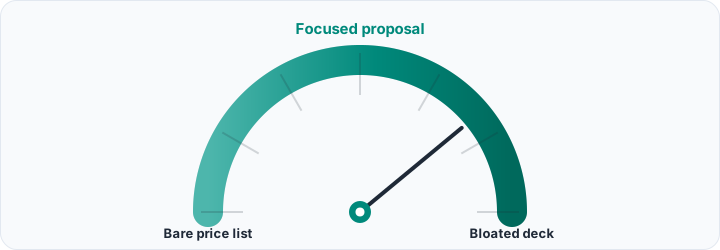
There's a balance, too. A bare price list is too thin; a twenty-page deck for every job tires the buyer and slows you down. The right proposal sits between: enough to decide on, short enough to read in one sitting.
Adapting the template to your own work
The same skeleton works for a web studio and a solar install; what changes is the weight of each section. In consulting, "situation" and "solution" stretch; in a standard product sale, "scope" and "price" lead. Build the template once, then decide which section grows per sector.
A good proposal doesn't persuade; it makes the decision easy. It removes the friction that keeps a customer from saying yes, not the doubt about your solution.
Think of a proposal as a flow, not a document: draft, send, remind, update where needed. Tracking that by hand gets hard even in a small team — the point is to build the skeleton once and repeat the same quality every time.
Frequently asked questions
Is a proposal the same as a price quote?
Not quite. A price quote is usually a short list of line items and a total; a full proposal also carries the situation, solution, scope and terms. For a simple, standard job a quote is enough; for complex or custom work, the full proposal is safer.
How long should a proposal be?
There's no fixed number. One page is often plenty for a small service job; a large project may run to a few pages. The measure isn't page count but whether the reader finds everything they need to decide in one sitting.
Should the price go first or last?
Usually in the middle, once context is set. Seeing the problem and solution first ties the price to a value. But make it easy to find, too — don't force a three-page hunt.
Do I have to put a validity date on a proposal?
You don't have to, but it almost always helps. A date creates polite urgency without pressure and protects you from an old price when your costs change.
A winning proposal wins on structure, not clever sentences: it opens with the customer's problem, draws the scope honestly, ties the price to a value, and closes on a single next step. Build the skeleton once, then fill it in for every customer. To run the whole thing — from drafting to follow-up — in one place, a CRM like Rocketly remembers the rhythm for you, so a good proposal wins because it was followed up on time, not lost because it was forgotten.