Topic clusters and pillar pages: building SEO authority on purpose
Random blog posts scatter in search. How topic clusters and pillar pages turn scattered content into a connected architecture that builds SEO authority on purpose.
Most small-business blogs are quiet graveyards. A post about "five quick tips" here, a holiday promo there, one earnest article somebody wrote two years ago and forgot. Each piece is fine on its own. Together they signal almost nothing, because a search engine sees a pile of unrelated pages rather than a business that clearly knows one subject cold. Topic clusters are the fix: a way to organize what you publish so the whole becomes worth far more than the sum of its posts.
This is an article about content architecture, not keyword tricks. We will look at what a pillar page and its cluster actually are, how to choose a topic worth owning, how to map and link the pieces, how to build the thing without burning out, and, honestly, when the whole approach is more than your business needs.
What a topic cluster actually is
A topic cluster has three parts. A pillar page is one broad, thorough page that covers a subject from end to end, the kind of page you would send someone who knew nothing about it. Cluster pages are the satellites: each one takes a single narrow question and answers it in real depth. And the internal links are the connective tissue, because the pillar points out to every cluster page and every cluster page points back to the pillar.
The shape is a hub and its spokes: instead of thirty posts scattered like loose change, one page is clearly the town hall and the rest are streets that lead to it.
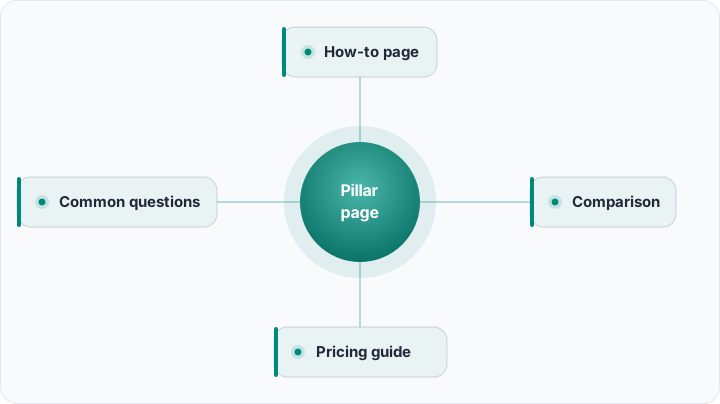
Why does this move the needle? Because search engines increasingly rank topics, not lonely keywords. A dense, interlinked web of pages tells them you have covered a subject properly, and that kind of depth is hard to fake.
Why a pile of random posts quietly fails
The most common problem is keyword cannibalization. Publish three thin posts that all circle "email marketing tips" and they compete with one another; the search engine cannot tell which one deserves to rank, so it often ranks none of them well. You end up bidding against yourself.
The second problem is that a single post on a subject reads as a dabble. One article about invoicing looks like an afterthought. Twelve linked articles about invoicing look like the work of a company that lives and breathes invoicing.
- Orphan pages pile up. Posts that nothing links to are hard for both readers and crawlers to find, and they quietly rot at the bottom of your sitemap.
- Effort scatters. Ten unrelated posts spread your authority across ten thin puddles instead of gathering it into one deep well.
Choosing a pillar topic worth owning
A good pillar sits in a sweet spot: broad enough to spawn eight or twelve genuine subtopics, yet narrow enough that a small business can plausibly become the best answer on the internet for it. "Marketing" is far too broad to own. "How a two-person law firm gets its first ten clients" is something you might actually win.
The second test is relevance to what you sell. A pillar that pulls in crowds who will never buy is a hobby, not a strategy. The topic should sit close enough to your offer that a reader finishing the pillar is a reader who could become a customer.
A quick gut check
Ask yourself: can I say something real and specific here that most competitors will not bother to? If the honest answer is no, pick another hill. A pillar you cannot out-teach is a pillar you will not out-rank.
Mapping the cluster into subtopics
Once the pillar is chosen, list every real question a buyer asks on the way to a decision; not the questions you wish they asked, but the ones they actually type at midnight. Each of those questions is a candidate cluster page.
It helps to spread those questions across the buyer's journey rather than clumping them all at the "ready to buy" end. Early, curious questions and late, comparison questions belong to different stages, and mapping them to the stages of the marketing funnel keeps you from writing ten versions of the same bottom-of-funnel page.

Aim for subtopics that do not overlap. If two planned pages would answer the same question, merge them; that is a future cannibalization problem you can prevent for free today.
The internal linking that does the work
This is the part people skip, and it is the part that turns a set of posts into a cluster. The rules are simple. The pillar links out to every cluster page. Every cluster page links back to the pillar, high up, with anchor text that describes the destination, not "click here" but the actual topic. Where two cluster pages are genuinely related, let them link to each other.
Anchor text is a small lever with real weight: it tells the search engine what the linked page is about, so spend it on "read more" and you have thrown a signal away. Descriptive, human anchors win twice.
A link the reader is glad they clicked is also a link the search engine trusts.
One caution: do not over-link. If every second sentence is blue, nothing stands out and the page starts to feel like a spam farm. And make sure the pillar's opening earns the attention it collects; the same discipline you would put into a clear value proposition belongs in the first screen of your pillar.
Building it without burning out
You do not have to publish the whole cluster on launch day, and trying to will exhaust you. A workable order: write the pillar first as a solid draft, then release one cluster page at a time, updating the pillar's links as each one goes live. Momentum matters more than a big-bang debut.
Consistency is what actually builds a cluster, which is why a simple content calendar beats occasional heroic bursts. One dependable page a week for three months is a cluster; four pages in a single frantic weekend followed by silence is not.
Remember that a cluster is not only prose. A pillar can hold an embedded explainer, and a well-planned video living on YouTube can be its own spoke feeding the same topic. And an old post, refreshed and linked into the cluster, is usually faster than a new one from scratch.
Turn your best content into booked conversations
Rocketly gathers the WhatsApp, Instagram and email leads your content earns into one inbox, so nothing your cluster attracts slips through the cracks.
See how Rocketly worksMeasuring whether it is paying off
Rankings for the head term are the obvious scoreboard, but they move slowly and they are not the only number that matters. Check whether individual cluster pages are ranking for their own long-tail questions, whether the pillar is attracting links from other sites, and whether visitors actually travel from one page in the cluster to another.
Traffic that never converts is a vanity metric with good posture. A cluster that pulls thousands of readers and produces no inquiries has a conversion problem hiding underneath a traffic success, and the fix is usually on the page, not in the search results.
When a cluster is not worth it
To be honest, this is not for every business. If you publish once a quarter, you do not have a cluster opportunity; you have a volume problem to solve first. If nearly all your customers arrive through referrals and word of mouth, the search channel may simply not be your lever, and pouring months into it is a bet against your own evidence.
Some businesses will get more from a tight local SEO setup than from a forty-page cluster: a plumber wants to rank for "emergency plumber near me," not to publish a treatise. And nobody should build forty pages for a product that sells to three buyers a month. Match the ambition of the architecture to the size of the prize.
Frequently asked questions
How many cluster pages do I need?
There is no magic count. Enough to cover the real questions around your pillar without padding, often somewhere between six and a dozen to start. Eight pages people actually finish beat twenty that nobody does.
Should I write the pillar first or the cluster pages first?
Either works, but a solid pillar draft first gives every cluster page a home to link to from day one. You will keep revising the pillar as clusters go live, so treat it as a living document rather than a monument.
How long should a pillar page be?
Long enough to genuinely cover the subject, and no longer. Depth is the goal, not word count. If a section is better handled by a dedicated cluster page, link to it instead of stretching the pillar to prove a point.
Do topic clusters help with AI answer engines too?
They tend to. Systems that summarize answers favor sources that clearly and thoroughly cover a subject, and a well-linked cluster is exactly that kind of source. The structure that earns trust in search reads as authoritative to answer engines as well.
A topic cluster is one of the few marketing assets that compounds: every cluster page you add makes the pillar a little stronger, and the pillar makes each new page rank a little faster. It is slow, and that slowness is precisely why competitors chasing quick wins rarely build one. Start with a single pillar you can honestly own, add one spoke at a time, and link them with care. And when that patient work starts sending real leads your way, make sure something catches them; Rocketly keeps every conversation your content earns in one place, so the authority you built turns into customers instead of missed messages.