What is Opportunity Radar? A guide to finding new customers with AI
Opportunity Radar is a new-customer engine that discovers the right companies in a large business pool, analyzes each with AI, and prioritizes by fit. What it is, how it works, and how to use it well.
Most sales teams wait for the customer to find them: an ad runs, a referral comes in, a form is filled, and a lead arrives. This "inbound" flow is valuable, but on its own it is not enough — because the vast majority of companies in your market will never reach out to you. They are out there, they need what you sell, yet they have no idea you exist. Opportunity Radar is built to close exactly that gap: a new-customer engine designed so that you discover the right companies. In this article we cover what Opportunity Radar is, why it matters, how it works, and what it adds to sales when used well.
To round out the topic, our guides on the ideal customer profile (ICP) as the basis of targeting, on data enrichment as the way to know a company, and on cold email for making first contact will complete this guide.
What is Opportunity Radar?
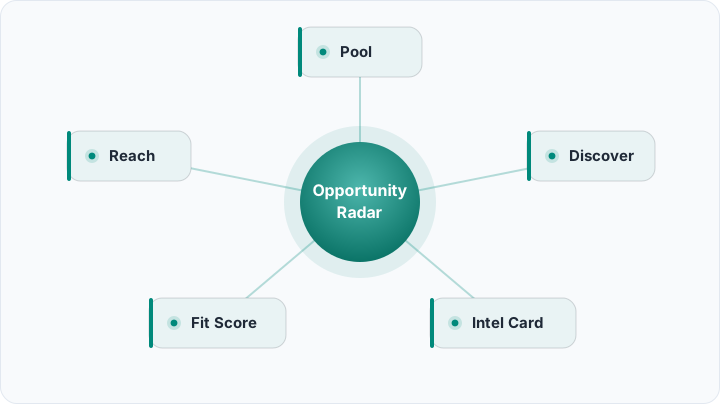
Opportunity Radar is a prospecting tool that lets you discover potential customers in a large business pool, analyze each company with AI, and reach out to the best-matched ones first. A classic CRM manages the customers and deals you already have; Opportunity Radar focuses on finding the customers you don't have yet. The two complement each other: the radar brings new prospects in, the CRM turns them into relationships and revenue.
In practice the radar does three things at once. First it gathers many companies into a single searchable pool. Then it reads each company from its digital footprint and enriches it: website, industry, size, technology, contact details. Finally it scores those companies against your target profile, answering the question "who should I talk to first" with data rather than instinct. The result is a focused sales flow that starts with the most likely customer instead of scanning random lists.
Why isn't waiting for inbound enough?
Inbound captures ready demand — but ready demand is only a small slice of your market. At any given moment, few companies have just become aware of their problem and are actively shopping for a solution; the large majority are either unaware of the problem or have not yet started looking. If you only wait for incoming leads, you never touch that large audience, and your growth stays capped by how much the market happens to come to you.
Outbound — active discovery — flips that equation: instead of waiting for demand to arrive, you find the right company and start the conversation yourself. The cost is that finding the right companies takes effort; sifting your matches out of thousands of firms by hand is tiring and slow. That is the real problem Opportunity Radar solves: by automating discovery, analysis, and prioritization, it makes outbound scalable.
How does Opportunity Radar work?
The radar's flow can be summed up in five steps, each feeding the next.

- Discover: You search the pool by criteria such as city, district, industry, and category; the relevant companies are filtered out of thousands.
- Analyze: An AI Intelligence Card is built for each company: digital maturity, technology in use, likely needs, and contact signals gathered into a single card.
- Score: Companies receive a fit score against the target profile you define; the one that resembles you most — the most likely customer — rises to the top.
- Reach: With masked contact, you reach the companies you unlock with credits; bulk email is supported within your plan limit.
- Convert to lead: An interested company moves into your CRM as a lead in one click, where it enters your normal sales process.
The strength of this flow is that each step narrows the previous one. You start with a broad pool, drop to the relevant ones through search, and down to the most likely ones through the score — so you spend energy on the highest-return companies, not on random ones.
The AI Intelligence Card: knowing a company
Knowing a company before you approach it cold changes conversion at the root. The AI Intelligence Card turns each company into a profile you can read at a glance. Signals gathered from the website and open sources are processed; what the company does, how digital it is, which technologies it uses, and why it might need your solution are summarized. This removes the hours a rep spends researching each company one by one and lets them enter the conversation prepared.
The value of the Card is not just collecting information but turning it into action. Seeing that a company's digital maturity is low tells you which value proposition to lead with; knowing its technology lets you personalize your message. We cover how this deep company intelligence is built in our data enrichment article.
The fit score: who to reach first?
When you have hundreds of suitable prospects, the real question becomes "who should I talk to first." The fit score answers it: it scores each company by how closely it resembles the ideal profile you define. A high-scoring company is one with both a high chance of converting and high value to you; you point your sales energy there first.
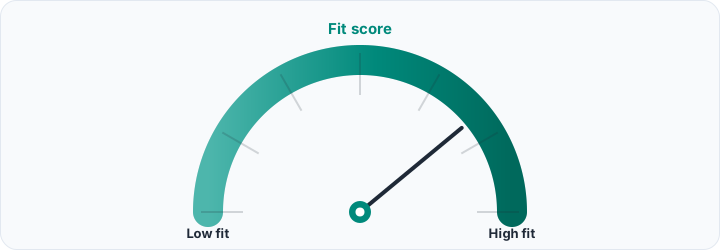
For the score to work, you must define your target profile well. Its basis is the ideal customer profile (ICP); once you define the shared traits of your most profitable, fastest-closing customers, the radar surfaces precisely the companies that resemble them. In other words, the score is not magic; it is a tool that scales your own definition.
Search agents: automating discovery
Manual search is powerful, but returning to the pool every day to check for new companies takes time. Search agents take this over: you define your criteria once (for example, "companies in Istanbul, in a given industry, with a website"), and the agent automatically finds and surfaces new companies that match. Discovery becomes not a one-off action but a continuously flowing source.
This is the practical version of the "always-full funnel" principle in sales. While agents run in the background, you focus on evaluating the incoming flow of prospects. You'll find a broader picture of fully automated sales agents in our autonomous AI sales agents article.
Who is Opportunity Radar for?
The radar speaks to any team for whom finding new customers is critical to growth. SMBs concentrated in a particular geography or industry can systematically discover companies they haven't touched yet. Service and consulting firms can target businesses that match their ideal customer profile. Any business with a sales team can free its reps to spend their time having conversations rather than building lists.
The radar is especially valuable when waiting for demand is too slow: when entering a new market, launching a new product, or trying to accelerate growth. In those moments inbound alone is not enough; active, targeted discovery is required.
Using it well: profile first, volume second
The way to get the most from Opportunity Radar is to focus on precision, not volume. The most common mistake is to try to reach as many companies as possible; yet a hundred touches to the wrong company produce less value than ten touches to the right one. So before you start using the radar, clarify your target profile: who is your best customer, in what industry, at what size, with what need?
Once the profile is clear, run the radar against it, start with high-fit companies, and personalize your message to each company's Intelligence Card. Volume is powerful when combined with the right profile; volume without a profile is just noise. Keeping outreach personalized rather than "the same message to everyone" both lifts conversion and protects your brand reputation.
The concrete payoff of Opportunity Radar
The radar is not a discovery toy but a tool that touches revenue directly. Its most concrete payoff is giving the sales team its time back: reps no longer research companies and build lists, they start conversations with ready, analyzed prospects. The second payoff is precision: thanks to the fit score, energy goes to the most likely customer, which means higher conversion and a shorter sales cycle.
The third payoff is predictability. When the top of the funnel is continuously fed by search agents, growth no longer hinges on the luck of "how many leads come in this month"; it becomes a controllable, scalable process. All told, Opportunity Radar makes outbound sustainable even with a small team: few people, many companies — but the right companies.
A scenario: how the radar works in practice
To keep it concrete, picture a short example. Say you are a team selling appointment software to small businesses, and you are looking for new customers to grow. Inbound brings in a few forms a month, but that doesn't meet your targets. You open Opportunity Radar and first define your profile: businesses in a given city that work by appointment, with a website but weak online-booking infrastructure. In seconds, the radar filters hundreds of matching companies out of the pool — a screening that would take you days by hand collapses into a single search.
Then you look at each company's Intelligence Card: whose site has no online booking, who still works by phone only? These are the companies that need your solution most, and the fit score has already surfaced them. You start with the twenty highest-scoring companies and write each a personalized message based on the Card: "I didn't see online booking on your site — how would it affect your business if customers could book outside working hours too?" You convert the interested ones into leads in one click and take them into your normal sales process. In three weeks, without building a single list by hand, you've built a funnel full of the right companies. That is exactly the radar's promise: reduce the effort of finding the right company to zero, and spend your energy on persuasion instead.
A common question: where does the data come from?
The pool is compiled from open business records and updated regularly; for each company the website and digital traces are analyzed to build the Intelligence Card. This turns research that takes days by hand into seconds. The data is not a one-off but a living source: as companies change and websites are updated, the profiles refresh too. So what you hold is a photograph of today, not of the past.
Summary
Opportunity Radar makes the hardest and most neglected part of sales — finding the right new customer — systematic and scalable. It discovers within a large pool, analyzes each company with AI, prioritizes by fit, and moves an interested company into your CRM in one click. Inbound captures demand; the radar creates it. When you use both together, your growth is measured no longer only by how much the market comes to you, but by how precisely you discover.
Don't wait for new customers — find them
Opportunity Radar searches a pool of 249,000+ businesses, finds companies that match your target profile, analyzes each one with an AI Intelligence Card, and turns it into a lead in one click. Sell with data, not guesswork. Try it free.
Start Free