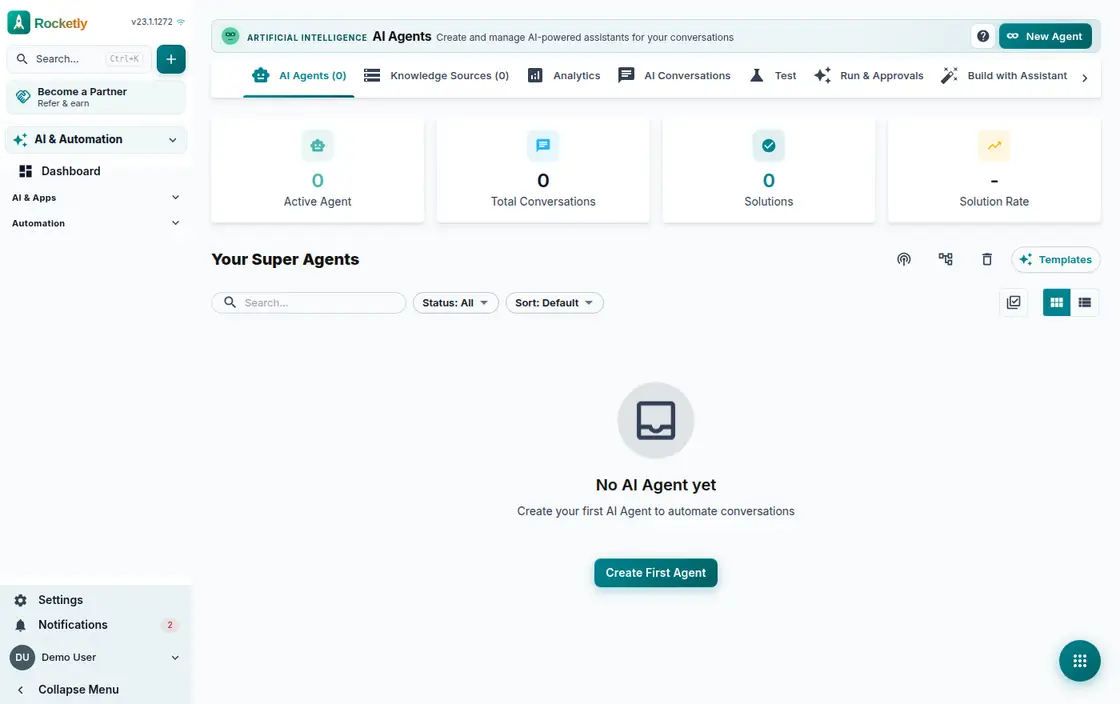
What you can do
Agent roster and knowledge base
Each agent gets its own system prompt and a knowledge base fed by documents, websites or FAQs. You try it out in the test chat before going live.
Write permissions
An agent can only perform the actions you tick: opening a task, updating a lead status, sending a WhatsApp message. Everything else stays out of reach.
Approval policy and autonomy
Choose between human approval, reversible auto and fully automatic. Autonomy by topic lets sensitive subjects carry a rule of their own.
Safety guardrails
Forbidden topics, things never to reveal, conditions for escalating to a human and a blocked-action list add a second boundary on top of permissions.
Deterministic playbooks
Define steps that run in order, a trigger and a condition; the agent follows the flow you wrote instead of deciding freely. Dry-run simulates it first.
Preview, cap and audit trail
Run with no write side effects, set a monthly credit cap, and follow every execution and everything awaiting approval from the history.
A REAL SCENARIO
A real working day
The flow that helps a team decide before a meeting
Catching leads that arrive overnight
Leads dropping in from the form at night used to wait until morning. When a new lead arrives the agent runs the playbook, tidies the record, opens a follow-up task and sends the first message. Critical actions such as sending a quote wait in the approval queue, and the rep starts the day by clearing that list.
Who is it for?
They fit operations teams that need the same rule for recurring work such as lead routing, task creation, or standard follow-up.
SETUP PLAN
How to start
Choose one low-risk recurring step.
Define the trigger, owner, and reversal path explicitly.
Start in a limited scope and review outcomes and exceptions.
Content verified:
ANSWER CENTER
Frequently asked questions
Explore the questions teams ask before deciding, with short and direct answers.
Open a question to see the scope of the product and its practical boundaries.
What exactly does Smart Agents do?
Smart Agents help carry out recurring operational steps within defined triggers and permissions. The goal is to turn follow-up and routing work into visible rules, not to create an opaque automation layer.
Who is Smart Agents for?
They fit operations teams that need the same rule for recurring work such as lead routing, task creation, or standard follow-up.
What can I do with Smart Agents?
Agent roster and knowledge base: Each agent gets its own system prompt and a knowledge base fed by documents, websites or FAQs. You try it out in the test chat before going live. Write permissions: An agent can only perform the actions you tick: opening a task, updating a lead status, sending a WhatsApp message. Everything else stays out of reach. Approval policy and autonomy: Choose between human approval, reversible auto and fully automatic. Autonomy by topic lets sensitive subjects carry a rule of their own. Safety guardrails: Forbidden topics, things never to reveal, conditions for escalating to a human and a blocked-action list add a second boundary on top of permissions. Deterministic playbooks: Define steps that run in order, a trigger and a condition; the agent follows the flow you wrote instead of deciding freely. Dry-run simulates it first. Preview, cap and audit trail: Run with no write side effects, set a monthly credit cap, and follow every execution and everything awaiting approval from the history.
What does Smart Agents look like on a real working day?
Catching leads that arrive overnight. Leads dropping in from the form at night used to wait until morning. When a new lead arrives the agent runs the playbook, tidies the record, opens a follow-up task and sends the first message. Critical actions such as sending a quote wait in the approval queue, and the rep starts the day by clearing that list.
How should a team start with Smart Agents?
Choose one low-risk recurring step. Define the trigger, owner, and reversal path explicitly. Start in a limited scope and review outcomes and exceptions.
What does Smart Agents not replace?
An agent cannot exceed permissions it has not been given. Customer communication, money movement, and policy changes that require approval should not be automated without human control.
Which industry was Smart Agents verified for?
The verified industry scenario for Smart Agents is Digital Agency. The industry page shows that end-to-end workflow. Other products used alongside it in the same scenario: GEO Visibility.
Used together in the same industry
Start using Rocketly for free
Bring your team together in one CRM; no card needed to set it up.