CRM for insurance agencies: never miss a renewal, grow clients
Do renewal dates slip, quotes die without follow-up, and cross-sell never happen? A CRM for insurance agencies unifies renewal tracking, the quote pipeline and the client/policy record.
An insurance agency's business is built on renewals and relationships. Most of its revenue comes not from new sales but from policies renewing year after year and from clients who hold multiple policies. The recurring challenges are clear: tracking dozens or even hundreds of renewal dates (miss one and the client lapses or goes elsewhere), following up on quotes, and staying in touch so clients renew and buy more. Many agencies run all of this on spreadsheets, a carrier portal and memory, and that leaks both renewals and quotes. A CRM gives the agency one system for clients, policies, renewal dates and follow-up. This guide explains what a CRM does for an insurance agency, where it protects the most business, and where its limits are.
Why agencies lose business without a system
Without a central system, the same problems recur in agency after agency. Missed renewals: when renewal dates are tracked in a spreadsheet or in memory, eventually one slips, and the client either ends up without coverage or moves to a competitor. Lost quotes: a quote goes out, the client thinks it over, and without follow-up the opportunity quietly dies. No cross-sell: a client with only one policy could be sold a second, but if no one prompts it, that revenue never happens. Scattered client and policy information: when a client's policies, history and communication are spread across different places, the agency starts from scratch every time and cannot see the client's full picture.
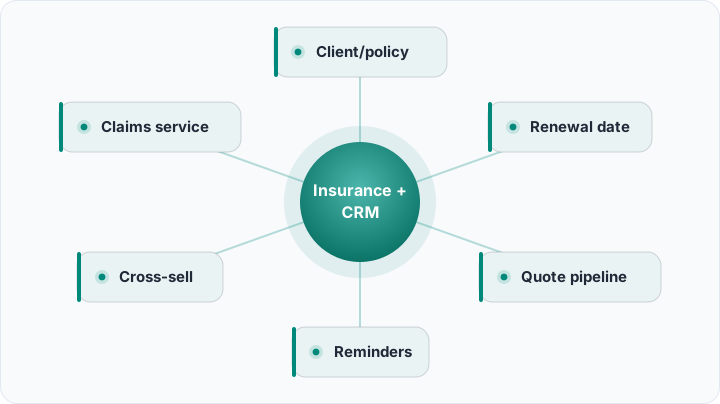
The common thread is that the agency's client relationship is spread across spreadsheets, a portal and memory rather than held in one reliable place. A CRM addresses this by becoming the single record of every client, policy, renewal date and conversation, so no renewal, no quote and no opportunity slips through the cracks.
Never miss a renewal
For an agency, the biggest win is never missing a renewal. A CRM can track each policy's renewal date and send reminders to both the team and the client well before the time comes, so no renewal slips to the last minute or into the past. This is the insurance version of appointment and reminder automation: instead of important dates sitting in a spreadsheet, the system surfaces them at the right time. Because renewals are the backbone of an agency's revenue, this is directly customer retention: a client reminded in good time and served well renews; a forgotten client is lost. Tracking renewals systematically closes most agencies' single biggest leak.
The quote pipeline
Bringing in new business is, in CRM terms, a sales process. Every quote request, whether it arrives by phone, web form or referral, becomes a tracked record that moves through clear stages: request received, quote sent, followed up, bound. With this pipeline, no quote is forgotten, every request is followed up in time, and the agency can see how many quotes actually turn into policies. Better still, follow-ups can be automated: when a quote sits untouched for a few days, the system can create a reminder. This is sales automation applied to the agency, turning more of the quotes you send into policies you win.
One client and policy record
Underneath all of this is a single client record. Instead of reconstructing a client's situation from scattered files every time, anyone authorised at the agency can open one record and see who the client is, which policies they hold, their renewal dates, the history of communication and what is outstanding. This makes clients feel recognised whenever they call and lets the agency serve them from an accurate, complete picture. This shared record is the same principle that underpins any CRM, the idea explained in our guide to what a CRM is. (Note that this is the relationship and policy-tracking record, not the carrier's rating or policy systems, and it works alongside them.)
Cross-sell and multi-policy
An agency's most profitable growth often comes from existing clients. A client with only auto insurance could be sold home insurance, a business could be sold an additional line of coverage, and clients who hold multiple policies are both more valuable and less likely to leave. A CRM makes visible which policies each client holds and where the gaps are, so the agency can suggest the right additional coverage at the right time. Without a system these opportunities are invisible; with one, the full potential of each client relationship comes into view.
Service at claims and renewal time
The moments that decide whether a client stays are usually claims time and renewal time. Fast, attentive service at a claim can make a client loyal for life; neglect pushes them to a competitor. A CRM keeps every interaction and follow-up on one record, so the agency is responsive and organised at these critical moments, with who is in a claim, what the next step is, and who needs following up always visible. Handling these moments well pays off when renewal time comes around.
Winning back lapsed clients
Beyond the regular renewal cycle, every agency has a quieter problem: former clients who left altogether. They may have moved their policies elsewhere one year, or let their coverage expire and never come back. In a spreadsheet-and-memory setup these clients are effectively invisible, because nothing flags that someone who used to renew every year is no longer around. A CRM makes them visible. Because it holds each client's history and last policy date, the agency can identify everyone who has lapsed beyond a chosen threshold and run a deliberate win-back outreach: a friendly message inviting them back with a fresh quote. Some will have settled elsewhere, but a meaningful share simply drifted and will come back when reminded. Winning back even a fraction of an agency's lapsed list is often easier and cheaper than acquiring brand-new clients.
A concrete example
Picture an agency that kept renewal dates in a spreadsheet and quotes in memory. Some renewals were missed in busy months and clients moved to competitors; many quotes that went out died because they were not followed up; and most clients had been sold a single policy with no additional coverage ever suggested. After adopting a CRM, every policy's renewal is tracked and an automatic reminder goes out when it is due, so the renewal rate rises. Each quote becomes a tracked record with a clear next step, so none are dropped. The agency sees all of each client's policies on one record and cross-sells at the right time to fill the gaps. A year on, the agency loses fewer renewals, wins more of its quotes, and holds more policies per client, without adding staff.
A documented trail of every interaction
Insurance is a regulated business where what was offered, disclosed and agreed can matter later. Because a CRM logs communication and activity on each client's record, the agency keeps a clear, timestamped trail of when a renewal notice went out, what coverage was discussed, and how a request was handled. If a client ever questions whether they were told about a change or offered a renewal, the record shows what happened rather than relying on someone's recollection. This is not a substitute for formal compliance systems, but a well-kept activity history protects the agency in disputes and makes audits far less painful, because the story of each relationship is written down in one place as it unfolds rather than reconstructed after the fact.
What a CRM is, and isn't, for an agency
It is worth being clear about scope. A CRM excels at the relationship and business side of an agency: clients and policy tracking, renewal dates, the quote pipeline, cross-sell, communication and claims-time service. It is not, by itself, a rating or policy-management system with insurance-technical functions like pricing, issuing policies or shopping carriers; agencies use dedicated software for that. The honest way to think about a CRM is as the system that makes sure the agency never misses a renewal, wins more quotes, and grows every client, the connective layer over the client relationship, whatever insurance software sits beneath it. The two work well together.
How Rocketly fits an insurance agency
Rocketly gives an agency one place for its client relationships and the work of winning and protecting business. Each client can have a single record with all their policies and history; renewal dates can carry reminders so no renewal is missed; quotes can flow through a pipeline and their follow-ups can be automated; and cross-sell opportunities can be made visible. Because everything lives on one record and one timeline, anyone authorised sees the full picture. To understand the foundation this all rests on, start with our guide to what a CRM is, and consider which parts of your agency are about the relationship and which need insurance software alongside.
Conclusion
An insurance agency lives on renewals and relationships, and managing both from spreadsheets and memory leaks business. A CRM gives the agency reminders that ensure no renewal is missed, a pipeline that turns more quotes into policies, cross-sell visibility that grows every client, and a single record that remembers the client relationship. Used for what it does best, it lets an agency win more renewals, hold more policies and keep more loyal clients without growing its admin burden. Start by tracking every policy's renewal date in one system with reminders and managing your quotes as a pipeline, and build from there.
Never miss a renewal, grow every client
Rocketly brings policy renewals, quotes and the client relationship into one place, so renewals don't slip and quotes get followed up. No credit card required.
Start Free