CRM for wholesale and distribution businesses: managing the relationship, not recording orders
CRM for the wholesale/distribution business: account & term tracking, price lists, reorder patterns, inventory visibility, dealer network, field sales, and collection discipline.
The wholesale and distribution business resembles neither retail nor one-off B2B sales. The same customers order again and again, relationships span years, margins are thin, and volume is everything. A generic CRM designed for one-time deals misses what actually matters here: reorder patterns, credit terms, price lists, and the health of long-term accounts. A wholesaler's CRM should be a "relationship management" tool, not a "deal-closing" tool.
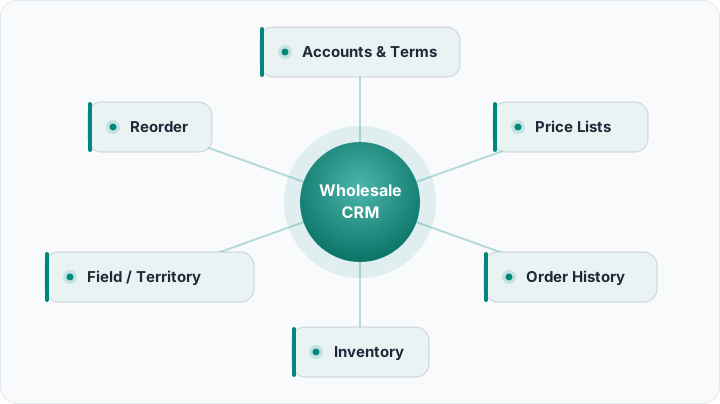
In this guide we cover the difference of wholesale/distribution sales, the central role of account and term tracking, price lists, the goldmine value of reorder patterns, inventory visibility, dealer network management, and how to bring all of this together in a CRM. The goal is to manage the wholesale business as a whole of revolving and growing relationships, rather than seeing it as merely a sum of individual orders.
The difference of wholesale/distribution sales
The nature of the wholesale business is recurring. A retail customer may buy once and leave, but a dealer or corporate buyer orders regularly every month, every week. This shifts the focus of sales from "finding new customers" to "keeping the existing relationship healthy and growing it." Also, margins are usually thin — which is why efficiency, correct pricing, and collection discipline are critical. And a large number of products (SKUs), a large number of customers, and deferred payments complicate the business. A generic CRM can't carry this complexity.
Account and term tracking: the heart of wholesale
In the wholesale business, the most critical data is who owes how much and the status of terms. Deferred-payment sales are the norm of wholesale; so each customer's account balance, credit limit, and receivable aging (which invoice is how overdue) must be continuously visible. In a thin-margin business, an uncollectable receivable can wipe out most of the profit. That's why account tracking is the heart of a wholesaler's CRM — collection must be managed as much as sales.
Price lists and tiered pricing
In the wholesale business there isn't a single price. Different dealers, different volumes, and different agreements require different prices — tiered pricing (a better price for those who buy more) is common. Managing these price lists by hand in a spreadsheet increases both the error risk and the "which customer did I give which price?" confusion. A good wholesale CRM automatically applies the right price list to each customer and ensures the right price comes up at the moment of order. This preserves both speed and consistency.
Order history and reorder patterns
The most valuable treasure of the wholesale business is order history. A customer's past orders reveal when and how often they order — that is, the reorder pattern. Knowing this pattern lets you be proactive: a signal like "this customer usually orders at the start of the month and hasn't yet" prevents a missed sale. A reactive wholesaler waits for the order to come; a proactive wholesaler sees the pattern and reminds at the right moment. Order history is the map of both retention and growth.
Inventory visibility
In the wholesale business, sales and inventory are inseparably linked. Promising something you can't ship undermines the relationship; taking an order for a product you don't have, or conversely, failing to sell what's in stock, is a two-way loss. Combining the order process with inventory management instantly answers the "can I fulfill this order?" question. Without this visibility, the wholesaler either over-promises or misses the opportunity in hand.
Dealer and partner network management
Many distributors sell not directly to the end customer but through a dealer or partner network. Managing this network — how much each dealer sells, which needs support, which is growing — is a discipline in itself. The CRM for dealer and partner sales approach offers the way to manage this multi-layered relationship: tracking each partner as a separate relationship, but also seeing the health of the whole network as a whole.
Field sales and territory management
Wholesale sales often happen in the field — reps roam their territories, visit dealers, take orders on-site. So the field team's mobile access to the CRM is critical: being able to see the customer's history, the price list, and inventory status from their phone enables taking accurate orders instantly in the field. Territory-based management — which rep is responsible for which territory, each territory's performance — organizes the field and prevents overlaps.
Quote and order speed

A customer who orders regularly doesn't want to wait for a long quoting process each time. In the wholesale business, speed is a competitive advantage: preparing a fast price quote with the right price list and processing the order quickly retains the customer. Being able to repeat past orders with one click reduces friction in repeat purchases. A slow and error-prone order process, in a thin-margin business, pushes the customer to a competitor.
Credit risk and collection discipline
In the thin-margin wholesale business, bad debt (uncollectable receivables) hurts especially — because while your profit on a sale is small, the principal you lose is large. So managing credit risk is essential: which customer has exceeded their credit limit, whose payments are late, which has become risky must be continuously tracked. A good CRM makes collection systematic by surfacing receivables that are near and past due — so profit doesn't evaporate in uncollectable invoices.
Growing the wholesale business with a CRM
When all these pieces come together, the wholesale CRM gives you a holistic picture of the business: which accounts are growing, which are shrinking, whose reorder pattern broke (a churn signal), which product can be recommended to whom. A sales CRM, in the wholesale context, is far more than an "order-recording" tool — it's a management tool that tracks the health of long-term relationships and shows growth opportunities. In the wholesale business, the winner isn't the one who finds the most new customers but the one who best manages and grows existing relationships.
Manage your wholesale relationships from one place
Rocketly shows account and term tracking, order history, and reorder patterns together, so you clearly see each dealer's health and growth opportunity.
Start FreeCommon mistakes
- Neglecting accounts and terms: In a thin-margin business, uncollectable receivables wipe out most of the profit.
- Managing price lists by hand: The "which customer gets which price?" confusion creates errors and inconsistency.
- Not seeing the reorder pattern: Staying reactive misses sales preventable with a proactive reminder.
- Taking orders detached from inventory: Promises that can't be shipped undermine the relationship; missing the opportunity in hand is also a loss.
- Leaving the field team without mobile: Without customer history and inventory on the phone, accurate orders can't be taken in the field.
- Not tracking credit risk: Not noticing a risky account leads to large principal loss in a thin-margin business.
Getting-started checklist
- 1. Put accounts and terms at the center. Make balance, credit limit, and receivable aging visible.
- 2. Move price lists into the system. Let the right price apply automatically to each customer.
- 3. Track the reorder pattern. Derive proactive reminders from order history.
- 4. Tie the order to inventory. Let the "can I fulfill this?" question be answered instantly.
- 5. Give the field mobile access. Let the rep see customer/price/inventory from their phone.
- 6. Manage credit risk and collection. Surface late and risky accounts.
Frequently asked questions
Isn't a generic CRM enough for the wholesale business?
A generic CRM is designed for a one-time sales funnel and often doesn't meet wholesale's real needs — accounts/terms, price lists, reorder patterns, inventory linkage. In the wholesale business the relationship is recurring and the focus is retention/growth; so an approach that supports these dimensions makes a marked difference.
I have an ERP; do I also need a CRM?
An ERP usually manages the transactional side (inventory, accounting, order recording); a CRM manages the relationship itself (customer health, contact history, opportunities, reorder patterns). The two can overlap but answer different questions. For a small wholesaler, a CRM that organizes the relationship and collection surfaces growth opportunities the ERP can't see.
How do I use the reorder pattern?
By tracking each customer's past order frequency and timing, you can notice that an expected order is late and reach out proactively. This both catches missed orders and shows a break in the pattern (did the customer switch to a competitor?) as an early churn signal.
How do I manage the risk of deferred-payment sales?
By defining a credit limit for each customer and continuously tracking balance and receivable aging. A system that surfaces accounts exceeding the limit or with late payments lets you catch risk before it grows. In the thin-margin wholesale business, this discipline is one of the most important parts of protecting profit.
In the wholesale and distribution business, a CRM isn't a deal-closing tool but a system that manages long-term relationships. Its secret lies in putting accounts and terms at the center, organizing price lists, using reorder patterns proactively, and tying the order to inventory and collection. When you bring this whole together in one place, your wholesale business stops being a sum of individual orders and turns into a portfolio of relationships whose health you can track and grow.