Keyword cannibalization: when your pages compete with each other
When three of your own pages chase one query, all three lose. How to spot the overlap in Search Console, pick the page that should win, and merge the rest.
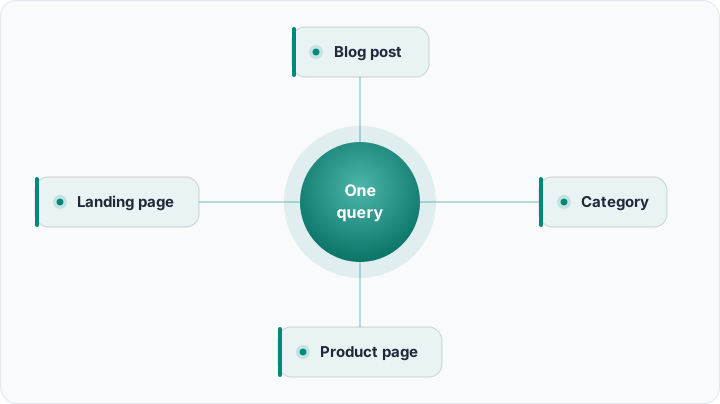
Thursday afternoon, three weeks after a new guide page went live with six weeks of work behind it. The marketing lead opens the target query in Search Console and does not see what she expected. Over the last ninety days, three different addresses from her own site have appeared for that query: a blog post from 2021, a category page, and the new guide. They trade places between positions eight and fourteen, week after week. Their combined clicks are lower than what the 2021 post earned on its own a year ago. Nobody outranked them. They outranked each other.
That is keyword cannibalization, and it is both more common and less catastrophic than the name suggests. This article separates what cannibalization is from what it is not, traces where the overlap comes from, shows how to read the symptoms in Search Console, explains why not every overlap deserves an intervention, sets out which page should win, covers the four fixes and the mechanics of a merge, handles product and filter pages, and describes the map that prevents recurrence.
What cannibalization is, and what it is not
Cannibalization is more than one page on the same site trying to satisfy the same search intent. The result is not that one page eats another, but that none accumulates full strength. With no clear candidate for a query, the search engine picks one on your behalf and changes its mind between crawls. From the outside that looks like a ranking that wobbles and a top five you never enter.
The damage mechanism is not a penalty either. Pages chasing one intent split the inbound links, the internal link weight and the behavioral signals between them. That is why cannibalization hurts most on competitive queries where the top five is genuinely hard to reach, and goes unnoticed on easy ones.
Three situations that are not cannibalization are worth ruling out first; it prevents half the unnecessary surgery. Two of your pages appearing together and both earning clicks is twice the real estate, not a problem. Several of your pages showing up on brand queries is expected. And pages that share words can still diverge in intent: how to issue an invoice and invoicing software carry the same noun and do entirely different jobs. Holding that line requires defining intent before keywords, the method we describe in keyword research.
Where the overlap comes from
Cannibalization is a memory problem, not a discipline problem. Every content operation older than three years has an article nobody remembers, and the new brief gets written over it. The second source is coordination: sales builds a landing page, content writes a guide, ecommerce writes a category description, all aiming at one query and none aware of the others.
The third source arrives with scale. When template-generated pages resemble each other too closely, the difference between them disappears for a search engine, and page families built through programmatic SEO carry the highest exposure. The fourth is location pages, where only the city name changes while the body stays the same, which is why localizing them matters in local SEO. The fifth is tag, filter and archive pages, which nobody on the team counts as content and the search engine counts anyway.
Reading the symptoms in Search Console
Cannibalization is diagnosed from a report, not a hunch, and it surfaces in one place: pick a query in Search Console and list the pages it lands on. A single query spread across three addresses in ninety days is worth a look, though that alone is not proof. The table below separates symptoms that genuinely indicate overlap from ones that merely resemble it.
| Symptom | How to verify it | Could it be a false alarm? |
|---|---|---|
| Two addresses alternating on one query | Break the query's page split down week by week | Yes: if both earn clicks, nothing is wrong |
| An older page drops when a new one ships | Overlay the publish date on the decline | No: this is the clearest signal there is |
| Position stuck in the 6-12 band | Count the pages targeting that intent | Yes: ordinary competition looks the same |
| The wrong page ranks for the query | Check which address the query resolves to | Yes: internal linking alone can cause this |
| Two pages on one topic, both weak | List the coverage of each side by side | No: this is a merge candidate |
Diagnosis turns into paranoia quickly, so the right entry point is the fifteen queries that matter most commercially: make sure each has one obvious candidate, and let the rest wait.
Three addresses, one query: reading the rotation
Rotation is the familiar signature of cannibalization, but it has to be read properly. Trading places week to week is not proof on its own; the proof is that none ever climbs into a higher band. If two pages rotate and one regularly reaches fourth place, the engine has made its choice and intervention may be unnecessary. Indecision is not movement in the rankings, it is the ceiling nobody breaks through.
Not every overlap deserves an intervention
The standard advice runs one way: find the overlapping pages and merge them. That advice has a serious limit. A merge can destroy long-tail traffic: when two pages serve related but distinct intents, folding them together loses more queries than the better ranking wins back. Before merging, export the query list each page brings in alone and ask whether one page can serve all of it.
Whether an overlap is harmful is answered by the combined clicks of the two pages, never by their positions.
The second limit is timing. A newly published page ranks erratically for weeks, and that volatility is routinely mistaken for cannibalization; intervene before the evaluation settles and you bury the page that was about to win. Six weeks of patience is usually the right call. The third limit: if you have two weak pages that do not actually overlap, your problem is quality rather than cannibalization, and the answer is a content refresh instead of a merge.
Which page should win?
Once you decide to intervene, the hardest question arrives: which page becomes the canonical answer? Weigh six criteria together.
- Intent fit: Whichever page most precisely satisfies the expectation behind the query wins, and no other criterion outranks this one.
- Inbound links: Retiring a page that accumulated links over years means starting over, and a portion is lost in every move.
- Conversion performance: The page with less traffic but more leads is the one teams sacrifice by accident; the measure is outcomes, not sessions.
- Page type: On a commercial query the winner is usually a product or category page rather than an article, and on an informational query the reverse holds.
- Internal link weight: The page your own site links to most has already received your vote, and moving that vote elsewhere is work you must plan for.
- Maintainability: The winner is the page somebody will still be updating in two years, so never crown one with no owner.
When these criteria conflict, one rule settles it: intent fit beats everything else. Crown a page with more links but the wrong intent and you keep the links while losing the ranking. Make the right-intent page the winner and redirect the link-carrying address into it.
Four fixes: merge, differentiate, redirect, canonicalize
There are four ways out, and the choice depends on whether the two intents really are the same. If they are, merge: consolidate the good material onto one page and redirect the other. If the intents differ but the texts fail to show it, differentiate: anchor each page's title, opening and scope to its own intent and link the two. That second path is the one most teams skip, and it is usually more profitable, because nothing is lost.
The third path is a redirect, for when the second page has no remaining reason to exist. The fourth is a canonical tag declaring which of two near-identical addresses is the original, the standard answer for filter and parameter pages. When you choose differentiation, place the pages in a hierarchy rather than side by side; the topic cluster and pillar content model exists to build exactly that hierarchy.
The mechanics of a merge
Merging is not pasting one text under another. The order matters: choose the winner, move the genuinely unique sections out of the losing page, restructure the winner around what arrived, and only then point the old address at it with a 301 redirect. Redirect before migrating the content and you will forget the migration, leaving readers on a page missing the part they came for.
The step teams skip comes last: internal link cleanup. Find every link pointing at the old address and repoint it. Redirect chains work, but each hop costs signal and speed, and how those chains accumulate and erode crawl budget is covered in technical SEO. Expect the ranking to dip for two weeks after a merge; panicking and reverting is the most common and most expensive mistake here.
Overlap on product, category and filter pages
In ecommerce, cannibalization has a different origin: nobody writes a second page, the system generates it. Color and size filters open separate addresses, sort parameters create duplicates, one product gets listed through two category paths. Most of this is a canonical-tag question, but filters with genuine search demand behind them, a specific material or use case, deserve real pages with unique content instead.
The second collision is between a category page and the best-selling product inside it. When the product description targets the category query, the two crash; the way to keep them apart is to point the category at choosing and the product page at buying. The working rules of writing product descriptions preserve that separation naturally.
Preventing recurrence: the keyword map
Cleaning up overlap is a project; preventing it is a habit. The habit has a name: a keyword map, a plain table where every target query has one owning address. The first check when a brief opens happens there: if the query already has an owner, the decision is not to write a new piece but to improve the existing one.
The practical way to keep the map alive is to store it inside the content calendar rather than next to it. Add two lines to the pre-publish checklist: who owns this query, and which existing page does this draft overlap with most? Adding them to your SEO blog writing process is an investment whose return grows with the team.
How do you know it worked?
The measure of success is not a higher position. The right measure has three parts: fewer distinct addresses for the target query group, more total clicks across it, and a winner whose conversions at least match what the two pages produced together. If the third part fails, you may have crowned the wrong page.
The first two weeks after a merge are noise, a trend appears around week four, and a decision becomes possible around week eight. Change nothing else on that page in the meantime, because no team that moves two variables at once ever learns which one worked.
The business-side version of this work is knowing which page actually produces leads, because without that the winner is chosen by guesswork. In Rocketly, records from web forms land on the customer card with the page and campaign they came from, so you see conversion at page level and decide on evidence; open a free account and set up that view for your own site.