Sales team turnover and how to reduce it
Sales team turnover is a management design problem, not an HR accident: what a departure really costs, where it starts, and how to reduce it for good.
It is Thursday morning and your second-best rep asks whether you have a minute. You know the rest of the sentence before it arrives. Half the deals being handed over are unfinished conversations, the biggest account calls to ask who looks after them now, and by afternoon the rest of the team is looking at each other differently.
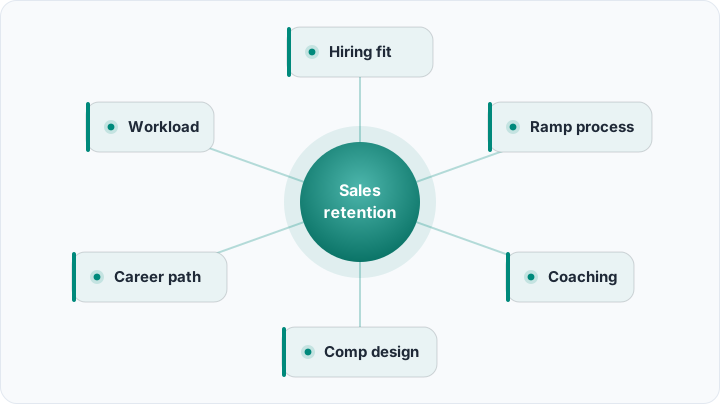
This piece treats sales turnover as a management design problem, not an HR accident: where departures come from, what they quietly cost, which signals show up months ahead, and what a manager can do about it even with a team of three.
Why sales turnover runs higher than in other departments
Sales is one of the few roles whose scoreboard resets every month. An accountant has no counter that returns to zero on the last day; a rep does. Add performance visible to the whole team, rejection as daily routine and partly variable income, and the pressure lands somewhere structurally different than elsewhere.
The second reason is the market: strong reps have leverage and can weigh an inbound offer cheaply. The third sits with management. The "figure it out as you go" school of onboarding leaves new hires alone in exactly the months when they decide whether the place is worth staying in, and people left alone leave, telling their teammates why.
High turnover is not the nature of the job. It is what happens when the pressure baked into the role meets a badly designed system. You cannot remove the pressure; you can fix the system.
Separate regretted departures from the ones you wanted
A single turnover number hides more than it reveals. If two people left an eight-person team, the question is who left: people who had been missing expectations for months, or the load-bearing members. The first is a healthy correction that exhausts everyone else when delayed. The second is an alarm, invisible under one blended figure.
Classify departures on two axes: voluntary or involuntary, and the performance band. Voluntary exits clustering in the top band say something is badly wrong between the comp plan and the manager. Involuntary exits clustering in the first six months point at the hiring profile, so rewrite the posting and the interview questions before letting anyone else go.
What a departure actually costs you
The visible part of a departure is payroll. The real weight sits in the lines nobody invoices. Naming them, without trying to price them, already changes the decisions you make:
- An uncovered territory or book: Accounts nobody owns, warm inbound requests waiting for a callback and quotes nobody follows up start leaking revenue from the first day of the notice period.
- Conversion loss on transferred deals: When a deal changes hands the relationship resets with it, buyers are less patient telling the story twice, and win rates on reassigned opportunities drop.
- Recruiting and training effort: The posting, interview rounds, product training and shadowing weeks are an investment a departure writes off before it pays for itself.
- Manager time: After an exit a manager's calendar fills with interviews, handover meetings and damage control, and those hours come straight out of coaching the people who stayed.
- Morale and trust: When a good person leaves, everyone behind quietly wonders whether they were right to go, and an unanswered question like that tends to produce the second resignation within months.
Root causes: turnover is almost always a design problem
The most common sentence in exit interviews is "I got a better offer." It is usually true and rarely the real reason. People do not walk away easily from a place where they are doing well; the conditions that made leaving easy were built months earlier.
The wrong hiring profile
Hire someone used to fast transactional closes into a long enterprise cycle and the ending is written on day one. Hire a purely inbound seller into a role that lives on cold outreach and you exhaust both of you. If the posting does not describe the real shape of the day, month three brings disappointment. We build the profile around the real job in sales rep onboarding and ramp.
Unrealistic quotas and a comp plan that keeps moving
A target most of the team misses is not a target; it is a demoralizing announcement. If nobody can explain how the number was built, or it quietly moves up mid-year, your strongest people notice first. The mechanics of a defensible number are in how to set sales quotas.
Poor lead quality and an empty pipeline
One quarter without enough real opportunities wears down even the most resilient rep. They do everything asked, results do not come, and then they answer for the results. That loop is the fastest producer of unfairness on a sales floor, and it usually starts with the quality of the marketing-to-sales handoff.
No coaching, micromanagement, and meeting load
Both extremes end in the same place. Someone who never gets feedback concludes they are not growing; someone whose every step is inspected concludes they are not trusted. The workable middle is a few hours of real coaching a week, autonomy after that. The article on sales coaching from conversation data shows how to build that balance on evidence instead of instinct.
The first 90 days decide most of it
The strongest predictor of whether a rep stays is how the first three months went. Three things carry that period: a written ramp plan, an early visible win, and knowing who to ask when stuck. None happens on its own; each is designed.
A ramp plan answers "what should I be able to do by when" week by week: when they pitch the product, run a demo alone, open their own opportunity. For the early win, hand them a small but real deal close to closing; a first signature carries for months. A mentor pairing sends questions to a peer, not the boss. The same discipline applies one level up, in the first 90 days as a sales manager.
How comp design affects retention
A comp plan's effect on retention comes far less from what it pays than from how predictable and fair it feels. A good plan answers three questions cleanly: what do I earn if I do this, how is it verified, and when can the rules change. When the answers are blurry, people assume the worst case and protect themselves.
What breaks fairness is usually not the plan but its exceptions: fuzzy territory lines, arbitrary inbound routing, late payouts, retroactive corrections. We build the mechanics in sales commission and comp plan. The narrow message here: changing the plan once a year with the reasoning shared openly costs far fewer people than fine-tuning it quarterly.
People rarely quit over a bad month. They quit because nobody could explain why the bad month happened.
The manager's weekly rhythm
Retention is produced in the weekly rhythm, not in an annual review. That rhythm has three parts: a one-on-one that never gets cancelled, one coaching topic grounded in data, and one obstacle the manager removes that week. To keep the agenda from drifting, borrow the structure in the sales one-on-one template.
The common mistake is spending all of it on numbers, which are already on the dashboard. The value sits in the behavior behind the number, the obstacle in front of the person, and one more question: which part of this job is wearing you down? Never ask it and you read the answer in a resignation letter.
Early warning signals show up months ahead
The decision to leave is usually made months before it is announced, and it leaves traces: a quiet drop in activity, a shift away from long-horizon deals toward whatever closes fast, silence in team meetings, no reaction to feedback, thinning CRM records. None is proof alone; two together mean it is time for a conversation.
Do not confuse burnout with intent to quit. A burned-out rep usually wants air, not an exit, and a workload adjustment at the right moment keeps them. We separate the two in sales team burnout and motivation.
Stay interviews, six months before the exit interview
Exit interviews are useful but late, and the person has already gone and softened what they say. A stay interview asks someone still on the team what keeps them here, what wears them down, and what they want to learn next year. Run it twice a year, on a different day from the performance conversation, or the answers stop being honest.
What to measure alongside the turnover rate
Tracking turnover alone is like taking a temperature and never looking for the illness. Read these together; each points at a different root cause.
| Indicator | What it tells you |
|---|---|
| Voluntary vs. involuntary split | Separates a management design problem from a hiring filter one. |
| First-year attrition | The fastest feedback on hiring profile, ramp plan and expectation setting. |
| Time to ramp | If it keeps stretching, training and mentoring are thin, not the hires themselves. |
| Performance distribution | When few people clear the number, the target design is the suspect, not the people. |
| Attrition in the top band | The sharpest warning about comp fairness, career path and the manager. |
Reading these fairly per person takes a consistent measurement frame, which is what the sales rep scorecard is for.
The system that prevents knowledge loss
The most expensive part of a departure is the context the person carried in their head: who actually decides at that account, what stalled the last call, which condition a pricing conversation hung on. If that lives only in a notebook, it leaves with them. Recording every conversation, quote and commitment in the CRM closes most of the gap; in Rocketly the shared inbox, deal card and quote history sit on one record, so whoever takes over does not rebuild the relationship.
A written handover protocol matters as much: a status note on every open deal before the last day, a joint email or call introducing the new owner, and one portfolio meeting with the person taking over. The same discipline applies after the sale, and the sales-to-customer-success handoff has its own rules worth reading separately.
Realistic moves for small teams, and the usual mistakes
A career ladder on a five-person team sounds impossible, but it is not. Use scope instead of titles: bigger accounts, a new vertical, mentoring the next hire, ownership of a process. People are fed less by a title than by the sense of moving forward. Your second advantage is speed: fix a problem the same week you hear it and you buy loyalty big companies cannot match.
The usual mistakes: countering after the resignation lands, since the person who stays usually leaves a few months later anyway; quietly redistributing the departed rep's work and manufacturing a second exit; telling the team late and vaguely; treating one bad quarter as a character flaw. None is a money problem; all are management choices.
Lowering turnover is not one heroic move but a system with clean records, clear targets and a predictable rhythm. To keep deal history, call notes and target tracking in one place, create your free Rocketly account and build your first pipeline today.