Tracking Brand Mentions: Where and How Your Name Appears in AI Answers
Do you know what AI says about you? How to track brand mentions in AI answers: whether you are named, the context, whether you are cited, and what to do next.
Picture a prospect who, researching a decision in your category, no longer opens Google to scan ten blue links. Instead they ask AI directly. They type which CRM is best for a small business in Istanbul into ChatGPT, or run an ordinary search and read the Google AI Overviews summary above everything else. Within seconds an answer appears — a handful of brand names, a one-line verdict on each, perhaps a few cited sources. And an uncomfortable question follows: is your name anywhere in that answer? If it is, how are you described, which rivals are you beside, and does the engine point to your own site as a source, or merely repeat what someone else wrote about you?
Most businesses cannot say, for a simple reason: they have never looked. We track our Google rankings, our social mentions, sometimes even our press coverage — yet the AI answer is a brand-new surface on which our reputation is being written, continuously and invisibly. This article breaks down what a brand mention inside an AI answer actually is, why it behaves nothing like classic web-mention monitoring, what to watch for when you read one, and what to do with the data once you start collecting it.
What a brand mention is, and why it is worth tracking
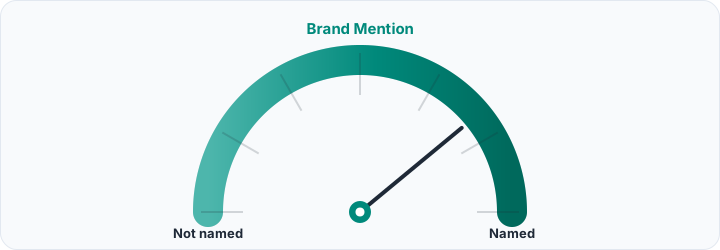
A brand mention in an AI answer is the moment a generative engine names your company inside the synthesized response it composes for a user's question. It is not a link waiting to be clicked; it is the engine deciding, on the user's behalf, that you are worth talking about, and writing you into the answer itself. In the discipline of generative engine optimization (GEO), that mention has quietly become the new currency of visibility.
The AI answer is often the buyer's first impression, and sometimes their only one. Before that person lands on your site, the engine has already assembled a shortlist on their behalf. If you are on it, you are in the running. If not, then for most of those users you simply do not exist — invisible at the moment a decision takes shape.
Classic web-mention tracking versus AI-answer mentions
For years, brand monitoring meant scanning the web for wherever your name turned up: a blog post, a news article, a social update. Those mentions are static. They live on a page, they have a URL, and a tool can crawl the web and find them for you. A mention inside an AI answer is a completely different animal.
A generative answer is produced on the fly. It does not sit on a fixed page; it is reconstructed each time around the user's exact question, their choice of words, and the language they ask in. Two people asking the same thing in slightly different ways can get two different answers about your brand — one that names you warmly, one that omits you entirely. That is why checking yourself once and concluding good, I show up is dangerously misleading.
In practical terms, the difference is this. Classic mention tracking looks backward and asks, where was I mentioned? AI-mention tracking has to be forward-looking and systematic. You decide in advance which buyer questions matter, put them to the engines on a regular cadence, and watch how the answers drift over time. It is less a one-off audit than an ongoing habit — closer to monitoring a vital sign than to reading a report.
What to watch: are you named, in what context, and are you cited?
When you actually read an AI answer about your category, three distinct signals are hiding inside it, and it pays to keep them apart. Blur them into a vague sense that we showed up and you will misread your real position.
- Are you named at all? The most basic signal: does your brand appear in the answer or not? If you are never mentioned, everything else is academic — the first job is to get inside the answer.
- In what context? Being present is not the same as being well represented. Are you framed as a leading option, or a footnote among other tools you could consider? Is the description accurate, outdated, or plainly wrong? And which competitors are named in the same breath?
- Are you actually cited? When the engine mentions you, does it link your own site as a source, or only paraphrase someone else's content about you? Being mentioned and being cited are different outcomes, and the gap matters; we unpack it in the difference between a mention and a citation.
Reading those three signals next to your competitors is what turns raw observation into strategy. If a rival's name keeps surfacing where yours is missing, you have a positioning problem, not a content gap. Working out whether AI is quietly recommending your competitor is inseparable from measuring your own visibility — the two questions are really one.
What to do with the data
Monitoring earns its keep only when it stops being a spectator sport: the point is not to know where you stand but to turn what you see into action. Brand-mention data tends to hand you three kinds of signal, and each calls for a different response.
- Gaps. Questions where you are never named expose a shortfall in content or entity signals. Pages that answer those exact questions directly and in plain language, backed by a clear, consistent brand identity, close the gaps over time.
- Competitor dominance. Questions where one rival leads answer after answer show you where to concentrate. You study the intent behind them and set out to become the better, more trustworthy, more quotable source.
- Wrong context. Where you are named but described incorrectly, the fault lies in the source material the engine learned from — your own pages, third-party references, your structured data.
The best time to build this loop is now, while most of your competitors are not looking at AI answers at all. Choosing to start measuring your AI visibility today gives you a baseline to compare against later and a way to tell whether your changes actually move anything.
Wrong or negative mentions
Sometimes the problem is not silence but distortion. An engine may describe you with outdated information, confuse you with a similarly named company, or echo a negative narrative it picked up somewhere. The natural first reaction is alarm — but drawing conclusions from a single answer misleads as much in the negative direction as in the positive.
The disciplined response is to look for patterns rather than react to individual answers. If the same wrong description recurs across many different questions and phrasings, that is worth taking seriously. And the remedy is almost never to correct the answer directly, because the engine is not stating an opinion — it is reflecting the sources it learned from. Durable correction comes from fixing those sources: updating the facts on your own site, presenting one consistent identity everywhere, and reinforcing the truth with authoritative third-party references and structured data, so the machine gradually learns the right story.
Measuring brand mentions with Rocketly
Turning all of this into a repeatable process is exactly what Rocketly's GEO Suite is built to do today. You define the buyer questions you want to follow — per language and market — and keep your brand and competitors together in one list. For each question, Rocketly measures whether your name appears in Google AI Overviews answers and whether you are cited as a source, and reports the results as a share of voice and a citation rate.
We will be candid about the boundaries. Google AI Overviews is the engine measured weekly as standard; ChatGPT and Perplexity measurement is in a controlled rollout and not yet available to every account. Trend history and drop alerts are available. To think clearly about which of these numbers deserve your attention — share of voice, citation rate, the competitor gap — our guide to the GEO dashboard and the KPIs that matter goes deeper. The aim is never to promise a result, but to replace guesswork with evidence — to make visible what has been happening entirely out of your sight.
Frequently asked questions
Can I not just search for my own brand to track mentions in AI answers?
Not reliably. Searching for yourself returns static web pages, whereas a generative answer is produced live for each query and shifts with the wording, the language, and even the individual user. You may be named in one phrasing and absent from another that means the same thing. For a picture you can trust, measure the specific buyer questions you care about systematically and on a regular cadence.
What should I do if AI describes my business wrongly or negatively?
Look at the pattern rather than a single answer: does the same error repeat across questions and phrasings? If so, you cannot edit the answer itself — but you can improve the sources the engine draws on. Update the facts on your site, present one consistent brand identity everywhere, and reinforce the correct information with authoritative third-party references and structured data so the model learns it.
Which engines does Rocketly track brand mentions in?
Today, Rocketly measures whether your brand and your competitors are named and cited in Google AI Overviews answers for the questions you choose to track, per language and market, weekly as standard. ChatGPT and Perplexity measurement is in a controlled rollout and not yet available to every account, and Gemini, Claude, and Grok are not measured. Trend history and drop alerts are available.