What Is llms.txt? The New Way to Introduce Your Site to AI
The AI era's new robots.txt moment is llms.txt. We honestly explain what this young file does, what it does not do, and how your SMB can create one today.
In the early days of the web, a tiny text file told search engines which parts of your site they could crawl: robots.txt. Almost nobody noticed it, yet that plain file was the first shared language between machines and websites. Today, in the age of AI, we stand at a strikingly similar threshold. Generative engines such as ChatGPT, Perplexity, Google AI Overviews and Gemini read your content, summarize it and cite sources while answering a user's question directly. But these systems do not browse patiently; within seconds, on a limited budget, they hunt for the most meaningful signal.
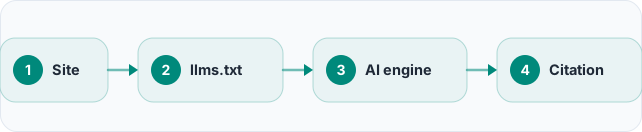
This is where a new proposal steps onto the stage: llms.txt. The purpose of this plain text file, placed at the root of your domain, fits in one sentence — to tell AI systems that the content which genuinely matters on your site lives right here. Where robots.txt declares what a crawler may visit and sitemap.xml lists every page, llms.txt answers a different question: if a language model wants to understand you, what should it read first? Below we explain, honestly, what it is, why it appeared, what it does and does not do, and how a small business can create one in minutes. This is a young, still-emerging convention, not a magic ranking switch.
What exactly is llms.txt?
Despite the name, llms.txt is not a complex technology. It is a plain text file that lives at the root of your domain — for example yoursite.com/llms.txt. Its format is deliberately simple and follows Markdown conventions: a heading with a one-sentence description of your brand, a short summary and, most importantly, a curated list of links to the pages you most want a language model to read. Beside each link you add a single line explaining what that page contains.
The idea is straightforward. When a language model arrives, instead of getting lost among menus, pop-ups, banners and JavaScript-loaded components, it holds a clean table of contents — an ad-free map of your site. Some implementations go further and offer plain Markdown versions of important pages, for instance page.html.md beside page.html, stripping the content of visual design entirely. In short, llms.txt does two things: it points to what matters and presents it in a form a machine can digest.
Why did it appear now?
llms.txt was born from how language models actually work. Modern web pages are built for human eyes: sliding images, cookie notices, chat bubbles, endless menus and content that appears only after JavaScript runs. A person filters this effortlessly; a model works within a limited context window — a finite amount of text it can process at once. The more cluttered your page, the harder it must work to find the real answer, and the greater the risk that your important information drowns in the noise.
Sites that reveal their content only by executing JavaScript in the browser are especially disadvantaged. Many AI crawlers do not fully run those scripts, so the very thing you want to communicate — your product description, your pricing logic, the scope of your service — may never reach the model. We explored the consequences of this in our piece on why AI skips your product page. llms.txt proposes an elegant fix: a shortcut that says, do not struggle to decode my markup — my cleanest, most accurate content is right here. The file was born not from a technical fad but from a real constraint in how models read.
What it does and what it doesn't
Honesty matters here, because inflated expectations are forming quickly around llms.txt. This file is a guidance and prioritization signal; it is not a ranking lever. Publishing one does not guarantee that ChatGPT will recommend you or that Google AI Overviews will cite you. No engine promotes your brand simply because the file exists.
It is also a young proposal, not universally adopted. What brings a standard to life is the number of systems that read it, and for llms.txt that adoption is still in its infancy; support varies across engines and keeps changing. So set it up not to lift your visibility overnight, but to be ready when more systems read it — and, meanwhile, to tidy your content.
What does it genuinely deliver? Three benefits. First, it forces you to select and distill your most important content, a discipline valuable on its own. Second, it makes your content easier for the systems that do read it to find and interpret correctly. Third, it creates a clear, machine-friendly record of how your brand describes itself. Small but real gains — as long as you treat the file as good etiquette, not a miracle.
A practical guide for SMBs: how to build a simple llms.txt
Good news: for a small business, a useful llms.txt takes minutes and needs no expensive tooling. Aim for clarity, not perfection. Follow these steps.
- Start with your identity. At the top, write an honest one-sentence description of your brand: what you do, who you serve and which market you operate in. This is where the model recognizes you as an entity.
- Choose only the pages that truly matter. Do not add every URL — llms.txt is not a sitemap. Prioritize answers to your buyers' most common questions, your core product or service pages, identity pages like about and contact, and a clear FAQ page.
- Add one line of context to each link. A note such as pricing — what the three plans include and who each suits — lets the model know what it will find before opening the page.
- Keep the text clean and current. Use plain, accurate sentences without marketing ornament, and update the file whenever you drop a product or change a service; stale information becomes a wrong citation.
- Publish it at the root. Make the file reachable at yoursite.com/llms.txt and confirm every link inside it works.
If you serve more than one language or market, consider a separate version for each — two audiences, two maps.
It is not enough on its own: the whole of GEO
llms.txt belongs in context: it is a tidy piece of a much larger picture. What truly determines your AI visibility is whether your content is crawlable, authoritative and structured. That holistic approach is called GEO, and we cover it in our foundational guide to what GEO is.
Think about it concretely. For a language model to read the links in your llms.txt, it must first be able to reach your site at all. If you block AI crawlers such as GPTBot or ClaudeBot at the server level, even the world's best llms.txt is useless. That is why the decision about which crawlers to allow and which to block is a more fundamental step that comes before llms.txt. Likewise, the pages the file points to must themselves be clean, authoritative and machine-readable; an elegant map pointing to an empty shell achieves nothing.
In short, llms.txt is polish over a solid GEO foundation: without the foundation, there is no surface to shine. Solve access and content quality first, then add llms.txt on top.
See its impact through measurement, not assumption
So you have set up your llms.txt — now what? The biggest trap is managing impact by feel. You cannot measure what you do not track, and you will never know whether something works if you do not measure it. AI visibility is exactly such an area: engines generate answers behind the curtain, naming your brand or not, without sending a single click.
That is why the sensible order is to measure first and improve second; we spell out why you should start measuring your AI visibility today. Rocketly's GEO suite was designed for exactly this: it tracks whether generative engines name you or your competitor, and whether they cite you as a source, for the buyer questions you choose to follow — then reports it as share of voice and citation rate. Google AI Overviews is measured weekly as standard; ChatGPT and Perplexity measurement is in a controlled rollout and not yet available to every account. A separate GEO Readiness Score gives a 0–10 prediction per page — a practical, page-level view of how the cleanliness and clarity you aim for with llms.txt are holding up. To gather these indicators in one place, our guide to which KPIs a GEO dashboard should include is a good starting point. Whatever the outcome, base your decisions on data rather than assumption.
Frequently Asked Questions
Does llms.txt replace robots.txt?
No — they do different jobs and coexist. robots.txt is a permissions file telling crawlers which parts of your site they may access; llms.txt is a guidance file showing the systems already allowed in which content is a priority. One manages the door, the other suggests where to look inside. Use both together.
If I add llms.txt, will ChatGPT or Google cite me?
There is no such guarantee, and be wary of anyone who promises one. llms.txt is a prioritization signal, not a ranking or citation lever, and engine support is still variable and evolving. What really determines whether you get cited is the accessibility, credibility and relevance of your content. llms.txt complements that foundation; it does not replace it.
Is building an llms.txt really worth the time for a small business?
Yes, but with the right expectations. The file itself takes minutes and forces you to choose your most important pages and describe them in plain language — a discipline that benefits your entire content strategy, well beyond AI visibility. Treat it as a low-cost, future-ready step, and track its measurable effects separately.