GPTBot, ClaudeBot, PerplexityBot: Should You Block or Allow AI Crawlers?
AI crawlers such as GPTBot, OAI-SearchBot, ClaudeBot and PerplexityBot do different jobs (training, search, user requests) and shape whether AI answers can use your pages. Learn how robots.txt works and what to block or allow.
There is a small text file at the root of almost every website — robots.txt — that quietly decides which automated visitors may read your pages. For years it was a sleepy corner of technical SEO. Then generative engines arrived, and that unassuming file became one of the most consequential switches a business controls: it can wave in the crawlers that feed AI answers, or lock them out. Most owners have never opened it.
Fewer still realize that a single line inside it can influence whether ChatGPT, Claude, Perplexity, or Gemini ever learn your business exists. This is the door you didn't know you could lock — and the question is whether you should. Blocking AI crawlers can feel like reclaiming control of your hard-won content; allowing them can feel like giving your words to machines that offer nothing back. For a Turkish SMB, the honest answer is more nuanced than either instinct, and getting it wrong either way carries a real cost.
Meet the crawlers knocking on your door
Every major AI company sends its own automated agents across the web, and each announces itself with a name — a user-agent — that your server can see and act on. Knowing who is who is the first step, because these bots do not all do the same job.
- GPTBot — OpenAI's crawler, which gathers public web content that may be used to train its foundation models. It is not the agent behind ChatGPT search: OAI-SearchBot is what surfaces websites in ChatGPT's search answers, and OpenAI says sites opted out of it will not be shown there. A third agent, ChatGPT-User, fetches a page when a ChatGPT user's request calls for it. Each of these settings is independent of the others.
- ClaudeBot — Anthropic's crawler, which collects web content that may be used to train its models. Anthropic runs two more agents: Claude-SearchBot, which indexes content to improve the quality of Claude's search results, and Claude-User, which fetches a page when someone asks Claude a question.
- PerplexityBot — Perplexity's indexing crawler, which builds the searchable picture of the web the engine relies on. A separate agent fetches specific pages in real time when a question calls for them.
- Google-Extended — not a crawler at all, but a robots.txt product token: Google fetches pages with its existing crawlers, and this token controls whether that content may be used to train future Gemini models and for grounding answers in Gemini Apps and Vertex AI. It does not affect inclusion or ranking in Google Search.
That distinction matters: opting out of Google-Extended does not remove you from Google Search, and it does not control AI Overviews or AI Mode either. Those are Search features, governed by your Googlebot rules and by snippet controls such as nosnippet, not by Google-Extended.
The real dilemma: visibility versus control
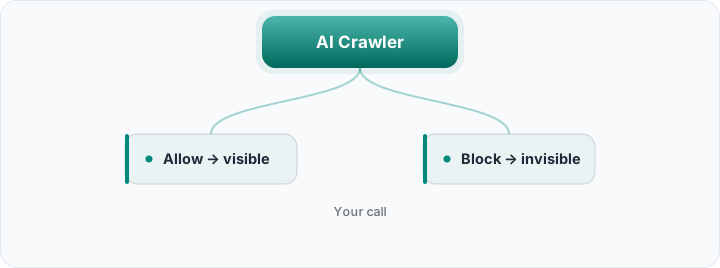
Beneath the technical names sits a genuine business tension. Allow the crawlers, and your content flows into the systems that increasingly answer your customers' questions — but you cede some control over how your words are reused, and usually get no direct payment and often no click. Block them, and you keep a tighter grip — but risk becoming invisible in the very place where buyers begin their research.
For a publisher whose business is paid article views, that tension is sharp. For most SMBs, it is not. Your website is not the product you sell; it is your storefront and best salesperson. If the place your buyers now ask which CRM suits a small Turkish team is an AI engine, being absent from it is not protecting an asset — it is drawing the curtains on your own shop window.
What robots.txt can — and cannot — do
robots.txt is a plain-text file at yourdomain.com/robots.txt. You steer each crawler with a short block that names its user-agent and states what it may access. The essentials are simple:
- To keep a crawler out completely, name it and disallow everything — a block reading User-agent: GPTBot followed by Disallow: /.
- To welcome it, either leave it unlisted, since the default is allowed, or state Allow: / explicitly.
- To make a nuanced choice, disallow only certain paths — keeping a members-only directory closed while your main marketing and product pages stay open.
Now the honesty many guides skip: robots.txt is a request, not a wall — a voluntary convention. Reputable operators — including OpenAI, Anthropic, Perplexity, and Google — publicly commit to honoring it for their crawlers, and generally do. The documented exception is fetching that a user triggers: OpenAI notes that robots.txt rules may not apply to ChatGPT-User, because those visits are initiated by a user, and Perplexity says Perplexity-User generally ignores robots.txt for the same reason. But the file carries no technical force: it authenticates nothing and blocks nothing at the network level, so a crawler that ignores the convention, or a bad actor forging a user-agent, sails straight past it. Genuine enforcement belongs at the server or firewall level, not in a text file. It is also worth knowing the complementary approach — llms.txt, a proposed standard for guiding AI systems to your most important content rather than simply shutting them out.
A decision framework for SMBs
So, block or allow? Start from your goal rather than the technology, and work through three plain questions before you touch the file:
- Is being found in AI answers valuable to my business? For nearly every SMB selling a product or service, yes — this is where discovery is moving.
- Is my content a paid asset I sell access to? For most SMBs, no. Marketing pages, product descriptions, and blog posts exist to be read by as many of the right people as possible.
- Do I have a reason to withhold one section? Perhaps — a members-only area, sensitive documents, or a library you monetize directly. That needs a targeted disallow, not a blanket one.
For most Turkish SMBs, the answers point the same way: allow the crawlers, because visibility in AI answers is worth far more than the sliver of control you would reclaim by blocking. The sophisticated middle path is selective, not all-or-nothing — allow the agents that surface you in live answers, and, if you object to model training on principle, disallow only the training-focused crawler while leaving the retrieval agents free.
Why blocking can quietly erase you from AI answers
Here is a rarely-aired risk. Block the agent an engine uses for search and live answers, rather than only its training crawler, and you can remove yourself from the pool of sources it trusts when building an answer. In generative search, the engine synthesizes an answer and points to its sources. If your pages were never readable, you are not a candidate to be one of those cited sources. The competitor who left the door open is.
This is why crawler policy is not a side issue but a foundation of Generative Engine Optimization (GEO), the practice of earning visibility inside AI-generated answers. It ties directly to how Google AI Overviews and the rise of zero-click search are reshaping discovery: when the answer appears above the links, being one of the sources woven into that answer is the entire contest. Block the crawler and you forfeit your seat at that table before the conversation even starts.
The honest nuance cuts both ways, though. Blocking is not a guaranteed disappearance. An engine can still mention your business from third-party sources — directories, reviews, news, forum threads, an encyclopedia entry — that describe you even when your own site is closed to it. So blocking rarely achieves clean exclusion; more often it just ensures that when you are discussed, your own words and latest facts are missing from the conversation.
You allowed them — but are you actually cited?
Opening the door is permission, not a promise. Allowing the agents that feed live answers — OAI-SearchBot for ChatGPT search, Claude-SearchBot, PerplexityBot, and Googlebot for AI Overviews — makes you eligible to be read and cited; it does not make it happen. Whether you are actually named and cited depends on the clarity, structure, and authority of your content — the substance of GEO. The only way to know where you stand is to look, not assume.
This is where measurement replaces hope. Instead of trusting that an open door is doing its job, you can start measuring your AI visibility today — checking whether the engines name you, cite you as a source, or reach for a competitor across the buyer questions that matter most to you. Tracking your brand mentions in AI answers turns a vague wish into a clear signal: are you present, in what context, and as a cited source or just a passing reference? Rocketly's GEO Suite is built for exactly this: it measures whether generative engines name and cite you for the questions you track — weekly for Google AI Overviews as standard, with ChatGPT and Perplexity measurement in a controlled rollout that is not yet open to every account. First you let the crawlers in; then you verify it was worth it.
Frequently Asked Questions
Does blocking GPTBot remove my business from ChatGPT?
Not reliably. Blocking GPTBot asks OpenAI's training crawler not to read your site going forward, but it does not erase what a model has already learned, nor stop the engine from describing you through third-party sources such as reviews, directories, or news. Remember, too, that different bots do different jobs: GPTBot is the training crawler, while whether your pages can appear in ChatGPT search answers is governed by OAI-SearchBot.
Will allowing AI crawlers hurt my Google ranking?
No. Crawlers such as GPTBot, ClaudeBot, and PerplexityBot are separate from Googlebot, which still handles classic Search, so allowing them does not change your traditional ranking. Google-Extended is a robots.txt token rather than a separate crawler, and Google states it does not affect a site's inclusion or ranking in Search. The main practical cost of allowing AI crawlers is a little extra server traffic — rarely a problem for a typical SMB website.
If I allow the crawlers, am I guaranteed to be cited in AI answers?
No. Allowing them is necessary permission, not a guarantee. Being cited depends on whether your content clearly answers real buyer questions and carries enough authority for an engine to trust it — the ongoing work of GEO. Because outcomes vary by engine and question, the sensible approach is to measure your actual visibility rather than assume the open door did the whole job.