Why CRM projects fail (and how to prevent it)
Why do CRM projects fail? Starting without a goal, lack of ownership, garbage data, no team adoption, excessive data-entry burden — 7 reasons and how to prevent each.
A CRM project rarely fails because of the software itself. The tool works, the features are there — yet the project still turns into a graveyard: a database no one enters, whose data isn't trusted, abandoned a few months later. The reality is that most CRM projects fail for human and process reasons: no clear goal, no team adoption, garbage data. Buying a CRM is easy; making it live is the hard part.
In this guide we cover the most common reasons CRM projects fail one by one and show how to prevent each. The goal is to avoid an expensive disappointment and turn your CRM into a genuinely used, value-producing system.
Why isn't a CRM a "software problem"?
Businesses often think "we chose the wrong CRM," yet the problem usually isn't the tool. Most modern CRMs handle the similar core functions more than adequately. Failure lies in wrong expectations, an unbuilt process, and most of all in people not using the tool. Changing the software doesn't solve these underlying problems — you'll fail with the same mistakes in a new tool too. So before the "which CRM?" question, you need to answer "why and how will we use the CRM?"
Reason 1: Starting without a clear goal
"We need a CRM" is not a goal. Without a specific problem you want to solve — like "our sales pipeline is invisible," "leads slip through the cracks," "customer history lives in people's heads" — no one can know what success looks like. A CRM project that starts without a goal turns into something everyone expects differently and that ends up meeting none of them. First define the concrete problem to solve; let the CRM be the solution to that problem, not a "nice to have" purchase.
Reason 2: Lack of ownership and a champion
An ownerless CRM project drifts. Without an internal owner (champion) who carries the project forward, makes decisions, and encourages the team, the CRM turns into something that's everyone's responsibility but no one's job. This person doesn't have to be a technical expert; they should be someone who knows the business and the team and believes in the project's value. Ownerlessness is one of the most common reasons even well-started projects gradually fade.
Reason 3: Starting too complex
Another common mistake is trying to configure everything from day one: dozens of custom fields, complex automations, everyone with a different request. This both paralyzes setup and overwhelms the team. The healthy path is to start simple and expand as you grow — first a lean setup meeting the core need, then new layers as they prove out. As we cover in our CRM implementation guide, a staged start brings far higher success than an "all at once" approach.
Reason 4: Garbage data
A CRM is only as good as the data inside it. Duplicate records, missing fields, and stale information carelessly migrated from old systems kill trust quickly — when the team doesn't trust the data, they stop using it too. Doing data migration cleanly and carefully prevents a chaos that's far harder to clean later. Garbage data isn't just a cosmetic issue; it's a structural risk that directly undermines adoption.
Reason 5: No team adoption (the biggest killer)
The number one reason a CRM project fails is the team not using it. If sales reps don't enter the CRM, however powerful it is, it's a dead database. Non-adoption usually arises from the CRM being made to feel like a burden to the team — being told just to "fill it in" without being shown what it gains them. The ways to drive CRM adoption run through making the tool a helper that eases their work, not a chore imposed on the team. Adoption is the lifeblood of the project.
Reason 6: Excessive data-entry burden
One of the most concrete causes of non-adoption is an excessive data-entry burden. If you put dozens of required fields for each record, sales reps rebel — they either enter incomplete/made-up data or avoid it entirely. Keeping the critical required and the rest optional, and automating where possible, is essential. Reducing data entry improves both data quality and adoption at once; because the team joins to sell, not to fill out forms.
Reason 7: Leadership not setting the example
The team does what leadership does — not what it says. If leaders don't use the CRM, don't pull reports from it, and don't ask "what does the CRM say?" in meetings, the team gets the message that using it doesn't really matter. Leadership putting the CRM at the center of daily work and basing decisions on the data there naturally embeds adoption without forcing it. A leadership that doesn't set the example pushes even the best-set-up CRM toward slow abandonment.
How to prevent it?
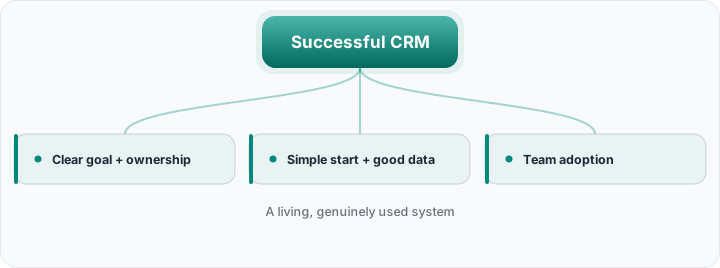
The reasons for failure are actually a prevention prescription. Set a clear goal and an owner. Start simple and keep data clean. And most importantly, manage adoption as a priority — show the team the value, reduce the burden, have leadership set the example. If these three pillars are in place, the CRM becomes not a graveyard but a living system that keeps the pulse of the business. Failing projects skip one or more of these pillars; those that succeed build all of them in sequence.
Defining success upfront

You can't measure whether a CRM project succeeded by "we bought and set it up." Define success concretely from the start: adoption rate (how much of the team actively uses it), data quality (are records current and complete), sales-pipeline visibility (can a manager see the state at a glance). Setting these metrics upfront lets you track whether the project genuinely produces value and correct it early if needed. A CRM project that isn't measured may be quietly failing where it's assumed to be succeeding.
What does a CRM do when set up right?
When these traps are avoided, the CRM delivers the promise at the moment of purchase: it gathers scattered customer information in one place, makes the sales pipeline visible, ensures no lead slips through the cracks, and eases the team's work. Choosing the right CRM is the first step, but what determines success comes after the choice: a clear goal, good data, and adoption. The software is a tool; what makes it valuable is the discipline behind it.
Make your CRM a living system, not a graveyard
Rocketly is designed to be a CRM your team genuinely uses — one that reduces data entry and eases adoption. Start simple, expand as you grow.
Start FreeCommon mistakes
- Starting with "let's get a CRM": Without a concrete problem to solve, success stays undefined.
- Leaving the project ownerless: Without an internal champion, the CRM drifts and fades.
- Configuring everything from day one: Excessive complexity paralyzes setup and overwhelms the team.
- Migrating garbage data: Untrusted data directly kills adoption.
- Putting too many required fields: A heavy data-entry burden makes the team flee the CRM.
- Leadership not using it: If leaders don't set the example, the team gets the "it doesn't matter" message.
Success checklist
- 1. Set a concrete goal. Which problem are you solving — write it clearly.
- 2. Assign an owner/champion. Have a person who carries the project forward.
- 3. Start simple. Begin with the core need and expand as you grow.
- 4. Migrate data cleanly. Do the migration carefully, don't bring garbage data in.
- 5. Manage adoption. Show the value, reduce the data-entry burden, have leadership set the example.
- 6. Measure success. Define and track adoption, data quality, and visibility from the start.
Frequently asked questions
Do CRM projects really fail often?
Yes, failure is common in CRM projects — but it almost always stems from human and process reasons, not the software. The good news is that most of these reasons are preventable: with a clear goal, ownership, good data, and adoption discipline, the success rate rises markedly.
If I chose the wrong CRM, should I change the software?
In most cases no — because the problem usually isn't the tool but the setup and adoption approach. If changing the software doesn't solve the underlying goal/data/adoption problems, you'll get the same result in the new tool. First fix these fundamentals; if there's a genuine functional shortfall, evaluate the change after that.
How do I convince the team to use the CRM?
Not by forcing but by showing value. The team needs to concretely experience what the CRM gains them — fewer lost leads, less manual work, clearer priorities. Reducing the data-entry burden, keeping the tool simple, and leadership setting the example make adoption natural without forcing it.
How soon should I expect results?
In a simple, focused setup, the first benefits (visibility, order) show within weeks; full adoption and measurable business impact can take a few months. What matters is defining success upfront and tracking it regularly — so if the project drifts you notice early and correct before it's too late.
CRM projects fail not because of software but because of goallessness, ownerlessness, garbage data, and non-adoption. Their secret lies less in finding the right tool than in building the right fundamentals: a clear goal, an owner, a simple start, clean data, and genuine adoption. When you put these pillars in place, the CRM stops being an expensive disappointment and turns into a genuinely used, living system that keeps the pulse of your business.