Wikipedia and Wikidata: Where AI Learns About Your Brand
Generative engines learn your brand largely from Wikipedia and Wikidata. Here is how to become a verifiable entity without forcing a Wikipedia page of your own.
Ask a generative engine "what is [company]?" and something quietly remarkable happens before it writes a single word. It reaches into a compressed model of the world it learned during training, and a surprisingly large share of that model's understanding of organizations, people, and products traces back to two closely linked sources: Wikipedia and its structured sibling, Wikidata. For your brand, the practical implication is blunt. The encyclopedia the machine carries in its head can shape how you are described as much as your own website does.
This is uncomfortable for most small and mid-sized businesses, because almost none of them have a Wikipedia page, and, as we will explain, most never will and do not need one. The reassuring part is that "being an entity the machine understands" is not the same thing as "having a Wikipedia article." This guide explains why AI leans so heavily on these two sources, why trying to force your way onto Wikipedia usually backfires, and what to do instead so that generative engines can describe your business accurately and with confidence.
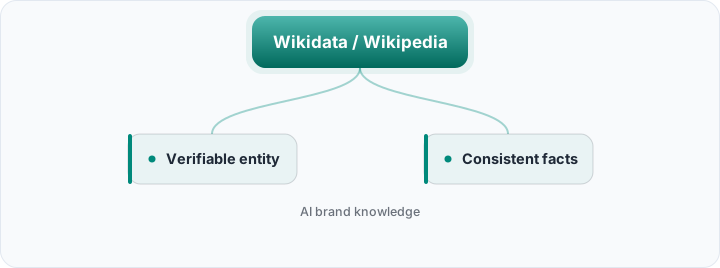
Why AI trusts Wikipedia so much
Wikipedia is one of the most heavily weighted text sources in the data behind modern language models. Part of that is sheer scale: it is vast, covers almost every topic, and exists in many languages. But size is not the real reason engines defer to it. The deeper reason is shape. Wikipedia is cleanly written, densely cross-referenced, and continuously curated by people who argue with each other about accuracy.
Two properties matter most. First, neutrality: articles are written from a dispassionate, encyclopedic point of view rather than a promotional one. Second, sourcing: every significant claim is expected to carry a citation to an independent, reliable source. That combination, neutral tone plus verifiable references, is almost exactly the profile of content that generative engines treat as trustworthy. Wikipedia also acts as an entity backbone: it supplies the canonical, one-paragraph answer to "what is this thing?" When an engine needs to summarize your category, your business model, or your history, it reaches for that encyclopedic frame first. The same authority dynamics decide which brand an AI chooses to cite over another, which is why understanding them pays off well beyond Wikipedia itself.
Wikidata: the machine-readable reference
Where Wikipedia is written for people, Wikidata is written for machines. It is a free, collaborative, multilingual knowledge base of structured statements: the quiet infrastructure that lets software reason about the world in facts rather than paragraphs.
Every item in Wikidata has a stable identifier and a set of properties: what kind of thing it is, what industry it belongs to, where it is headquartered, who founded it, and what its official website is. Each statement can carry its own reference. Crucially, Wikidata is a graph, a web in which entities are linked to other entities, to external identifiers, and to official channels. That web of links is what lets a machine disambiguate: to know that your company named "Orbit" is a software firm based in Istanbul, not a brand of chewing gum or a term from physics. Because Wikidata is freely licensed, its structured facts are reused across countless downstream products, from search knowledge panels to the answers assistants speak aloud. A clean, well-referenced Wikidata item is therefore one of the most direct ways to hand machines a set of facts about you that they can trust and pass along.
Notability: most SMBs will not be on Wikipedia, and do not need to be
Here is the honest truth that agencies rarely lead with. Wikipedia has a strict notability standard: to justify an article, a subject must have received significant coverage in reliable, independent, secondary sources. Press releases do not count. Your own website does not count. Paid placements do not count. A regional e-commerce shop, a boutique agency, or a local accounting firm usually does not clear that bar, and that is completely normal.
Two warnings follow. Do not create your own page: English Wikipedia's conflict-of-interest guideline strongly discourages editing articles about yourself or your company directly; it asks you to disclose the connection, propose changes on the article's talk page with an {{edit COI}} request, and submit new articles through Articles for Creation. Self-written promotional pages are routinely deleted. And do not pay someone to sneak one in. Promotional articles invite deletion, public warning banners on the page, edit wars, and reputational damage, and worse, they can seed your permanent entity record with distorted or contested facts that are painful to correct later. Wikidata's bar is different, not absent: an item must meet at least one of its notability criteria, which for a company without a Wikipedia article usually means being a clearly identifiable entity that can be described using serious and publicly available references. Unsourced, promotional entries get reverted or deleted. The reframe matters: absence from Wikipedia is not a GEO failure. Forcing your way in is.
Instead: become a verifiable entity
The real objective was never a Wikipedia article. It is to give machines a consistent, corroborated picture of who you are, so they can form a confident entity for your brand with or without one. Four habits do most of the work.
- Consistent identity everywhere. Use the same brand name, the same one-line description, the same category, and the same address and contact details across your website, social profiles, maps, industry directories, and review platforms. Contradictory details are the fastest way to breed machine doubt.
- Structured data on your own site. Describe your organization in markup, including name, logo, description, founding, and location, and explicitly list your official profiles so a machine can tie them together as one entity rather than several half-glimpsed ones.
- Authoritative third-party references. This is the small-business version of Wikipedia's citations: earned coverage in reputable local or trade press, membership in genuine industry associations, and listings in the catalogues your sector actually relies on. Independent corroboration is what turns a claim into a fact in a machine's eyes.
- A legitimate Wikidata presence where it truly applies. Wikidata can hold an item about an organization without a Wikipedia article if it meets the notability policy, but think twice before creating one yourself: Wikidata has no formal conflict-of-interest policy, yet its community essay on self-promotion strongly discourages creating items about yourself or your organization. Let independent coverage come first; if an item already exists, keep it strictly factual and sourced, fix clear errors, and request other changes on its talk page.
Getting into the knowledge graph
Behind all of this sits a larger idea: the knowledge graph, the machine's structured map of entities and the relationships between them. Wikipedia and Wikidata are major inputs to that map, but they are not the only ones; your own structured data and the wider web of references feed it too. The signals compound. Consistency, structured markup, and third-party corroboration reinforce one another until an engine is confident enough to name you and describe you correctly. If you want the mechanics, our explainer on how the knowledge graph turns your brand into an entity machines recognize goes deeper, and it sits inside the broader discipline covered in our guide to generative engine optimization.
Seeing the effect
You cannot watch a model train, but you can inspect what it produces. Ask ChatGPT, Perplexity, or Google's AI answers "what is [your brand]?" and read the result critically. Are the facts right? Is your category correct? Are you being confused with another company that shares your name? Mistakes here are entity problems, and they almost always trace back to the weak or contradictory signals described above.
The next step is to watch it over time rather than checking once, because entity work compounds slowly. Our guide to tracking how your name appears in AI answers covers what to record and how to read it. This is also where Rocketly fits: the Rocketly GEO Suite measures whether generative engines actually name your brand and cite you as a source for the buyer questions you track, reporting share of voice and citation rate. Google AI Overviews is measured weekly as standard, while ChatGPT and Perplexity measurement is in a controlled rollout. If you would rather begin with the fundamentals, start with our practical guide to measuring your AI visibility today. Becoming a verifiable entity is not a one-week campaign, but it is one of the most durable investments you can make in how machines understand and repeat your brand.
Frequently asked questions
Do I need a Wikipedia page to appear in AI answers?
No. A Wikipedia article helps, but it is neither required nor realistic for most small and mid-sized businesses. Generative engines assemble their picture of you from many signals, including your site's structured data, consistent listings, and independent references, so a well-corroborated brand can be named and described accurately without ever having an article.
Can I just create a Wikidata item for my business?
You technically can, but it is discouraged. Wikidata has no formal conflict-of-interest policy (a 2015 proposal closed without consensus), but its community essay Wikidata:Self-promotion strongly discourages creating items about yourself or your organization. Any item must also meet at least one of Wikidata's notability criteria; for a business without a Wikipedia article, that usually means serious, publicly available references describing it. If an item already exists, correct only clear factual errors with sources, request other changes on its talk page, and disclose any paid editing.
How long until AI describes my brand correctly?
There is no fixed timeline, and anyone promising an exact one is guessing. Engines refresh their knowledge on their own schedules, so entity work compounds gradually. The reliable approach is to fix your signals, keep them consistent, and monitor how the engines describe you over time rather than expecting an overnight change.