Farm & agribusiness CRM: buyers, contracts, harvest
A practical guide to organizing the selling side of a farm: knowing your buyers, tracking supply contracts, and moving each harvest to the right buyer on time.
The most tiring part of running a farm often has nothing to do with the field. The crop grows on its own; the real headache starts on the phone, when harvest is near and you have to decide who buys it, at what price, and on which day. A good agribusiness CRM is not sales jargon — it is a shared memory for the buyers, contracts, deliveries, and payments that keep a farm in business.
This article looks at the selling side of a farm or agribusiness: how to know your buyers, how to turn loose handshake deals into commitments you can actually track, and how to move a seasonal harvest to the right buyer at the right moment.
A farm is a relationship business too
Growing the crop is only half the work. Milking the cows, picking the hazelnuts, ripening the greenhouse tomatoes — that part is clear. The hard part is selling that output every single year at a fair price to a buyer who actually pays. What separates a good farmer from a good farm business is often not the yield in the field but the strength of the buyer book.
Say you run a dairy farm and send your milk to a nearby processor. The trust you built with that buyer, the years you have worked together, how you negotiated last season's price — all of it has real value. But if that value lives only in your head, it evaporates the day you hand the farm to your daughter or a key worker leaves.
That is why the relationship has to move out of one person's memory and into the shared memory of the business. It is the same logic behind CRM for consultancies and agencies: the relationship should belong to the organization, not to a single individual.
Know your buyers: they are not all the same
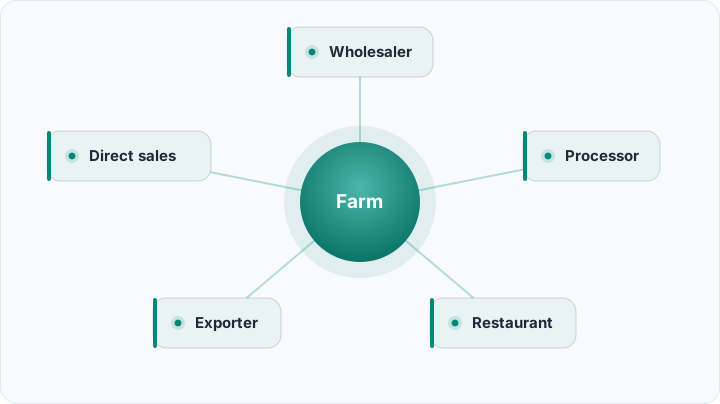
A farm's buyers are not one type, and treating them all the same quietly costs money. Each channel has its own volume, price, payment habit, and season.
- Wholesalers and commission agents: They take large volumes but set the price on the day; the relationship can run for years, yet the margin stays thin.
- Processors: A dairy, an oil mill, or a grain elevator usually buys on contract and buys steadily — stable, but it can lock you into a fixed price.
- Restaurants and hotels: Small, regular orders that pay for quality and expect fresh, on-time delivery.
- Direct and retail: A market stall, farm-gate sales, or a subscription box — the highest price, but the channel that demands the most labor.
- Exporters: Big volume and good money, with zero tolerance on grade, certification, and the delivery date.
Put these buyers in one list and note what each one takes, at what price, and when, and it becomes obvious who to call in which month. If you sell to restaurants, the piece on CRM for restaurants helps you see the deal from the other side of the table, through your buyer's eyes.
Supply contracts: from a handshake to a commitment you can track
In agriculture most deals still run on a word and a handshake. There is something good in that, but it is also where the "you told me this much" argument is born, right in the middle of the harvest rush.
Recording the agreement — whether it is a formal paper or a promise made over the phone — is what protects the relationship instead of straining it. Who took how much, at what price, in which delivery window; how much was delivered and how much is left. When you can see that, you never make the mistake of promising the same lot to two buyers.
Forward contracts matter especially here. If you fixed a price months before harvest, you need that commitment and its delivery schedule written down somewhere; otherwise, when the market swings, remembering who agreed to what gets very hard.
Planning around the season and the harvest
Timing is the cruelest part of farming. The crop waits, but not forever: tomatoes have to move within a week, while grain needs storage and ties up cash. Calling the right buyer at the right moment is often as decisive as the price itself.
Lay a harvest calendar next to your buyer list and a rhythm appears — which crop ripens when, which buyer is purchasing in that window, who you spoke to during these same weeks last year. That rhythm is what turns panic selling into planned selling.

Bringing the field and the office onto the same calendar is the challenge of any business with people out on the ground. If you want to see the same problem in a different trade, the logic in CRM for field-service businesses will feel familiar.
One inbox: WhatsApp, the phone, and the field
Let us be honest: a farm's orders do not live in a spreadsheet. They live in WhatsApp threads and phone calls. One buyer asks a price by message, another calls, a third settles it face to face at the field gate. Holding all of that in your head soon becomes impossible.
Pulling every one of those conversations into a single inbox — who said what, which price was discussed, which delivery was promised — recovers the revenue that most often slips away. Because most lost sales come not from a bad product but from a forgotten message.
Move your buyer book into a system
Rocketly gathers the orders coming in over WhatsApp, your contracts, and your collections on one screen, so the selling side of the farm stays in order.
Try Rocketly freePrice, quotes, and getting paid
Cash flow on a farm is lumpy: the money arrives in a rush with the harvest while the costs are spread across the whole year. That is exactly why you need to see clearly who owes what and which delivery's payment is running late.
Selling on deferred terms — "take the goods now, pay after harvest" — is common and keeps the trade moving, but untracked it turns into bad debt. Keeping every delivery, invoice, and incoming payment in one place turns chasing receivables from an awkward conversation into a routine reminder.
The bigger your volume grows, the more this matters. If you are serious about growing the wholesale side, the guide to CRM for wholesale and distribution shows how to treat it as a managed relationship rather than a stack of recorded orders.
What a CRM will not fix
Let us be honest about the limits. Software will not fix the weather, the world price, or a bad harvest. If your product is poor, no system makes it look good — at most it delivers the bad news faster.
And not every farm needs one. If you have two buyers total and have known both for years, installing software is extra weight; a notebook and a good memory are enough. A CRM starts to earn its place when your buyers, contracts, and deliveries grow past what one head can hold.
A CRM does not sell your crop for you. It only makes sure you never forget a buyer, a promise, or an unpaid invoice.
If you reach into distant markets the story changes; exporting adds a layer of grades and paperwork to track. For that stage, it is worth looking at CRM for e-export and foreign trade.
How to start simply
Do not try to build a big system on day one. Start with two lists in their plainest form: your current buyers and this season's commitments.
Then make it a habit to add every new conversation, every delivery, and every payment to the same place. By the end of one season you will hold a real map that tells you who to go to, and when, next year.
Frequently asked questions
Does a small family farm really need a CRM?
Not always. If you work with two or three steady buyers, a notebook may be enough. A CRM earns its keep once the number of buyers, contracts, and deliveries grows past what you can comfortably keep in your head.
How do I use it out in the field with no signal?
Most of the work runs on the phone and WhatsApp anyway, so the conversations gather in one inbox once you are back at the office or the house. The goal is not to enter data in the field, but to collect scattered information in one place.
Won't writing down verbal deals damage the relationship?
It does the opposite. A record backs up the memory, not the trust; it ends the "but you said" argument before it starts and protects both sides.
How do I track deferred-payment sales?
Record every delivery with its invoice and the expected payment date; the system reminds you of what is due and what is overdue, so collecting turns into a routine task instead of an awkward chase.
What keeps a farm standing is not only soil and labor; it is the buyers who come back every year, the promises you keep, and the deliveries you make on time. Move those relationships out of one person's head and into the shared memory of the business, and you will both sleep easier and negotiate better. A tool like Rocketly helps you hold that memory on one screen — but the real work is seeing a buyer not as a record, but as a relationship you keep tending.