Doubtful receivables & provisions
What is a doubtful receivable, when does it stop being a normal delay, and what does setting a provision mean? Early-warning signals and tracking, explained.
You made a sale, issued the invoice, and revenue showed up on your income statement — but the money never reached your account. As one due date slips past another, a doubt creeps in: will this doubtful receivable ever actually be collected? This is exactly where you need to classify the receivable correctly and, if necessary, set aside a provision, so you don't fall into the "profitable on paper, broke in the bank" trap.
In this guide we cover, in general terms, what a doubtful receivable is, when it stops being an ordinary delay, what setting a provision means in your books, and a simple tracking discipline that helps you spot all of this early. Important note: this is informational, not financial or legal advice; the formal conditions for doubtful receivables and provisions depend on local rules, so always consult your accountant before acting.
What is a doubtful receivable?
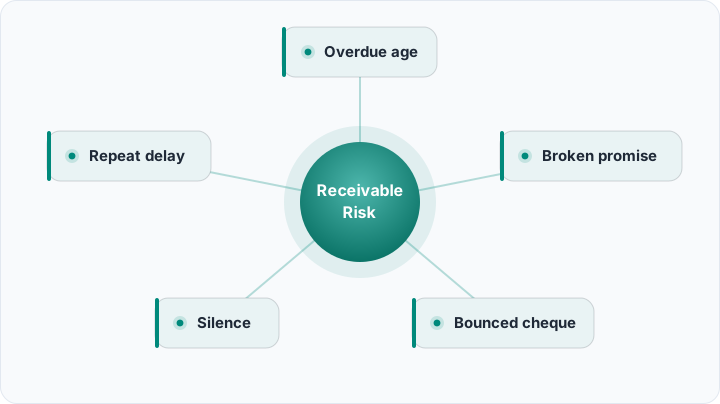
A doubtful receivable is an amount that is past due and whose collection has become uncertain. You are not yet saying "it's completely gone, I've written it off," but you can't say "it will definitely arrive" either — it sits in a grey zone. What separates an ordinary delay from a doubtful receivable is that collection is now seriously at risk: the customer can't be reached for days, repeated payment promises are broken, a cheque bounces, or the matter has moved to legal or enforcement proceedings.
This distinction matters because flagging a receivable as "doubtful" has consequences in your accounting. In general terms, a business can set a provision for receivables whose collection has become doubtful — that is, it reflects the reality that "some or all of this money may not arrive" in the financial statements. The formal conditions (whether a lawsuit or enforcement is required, which receivables qualify) depend on the rules and fall within your accountant's remit; you build the right tracking on the business side, and they handle the right treatment on the books.

When does an overdue amount become "doubtful"?
Not every late payment is a doubtful receivable. If a regular customer settles an invoice a few days late, that is usually an ordinary cash-flow fluctuation. A receivable only becomes doubtful when the likelihood of collection genuinely weakens. In practice, the alarm bells ring when these signals combine: a balance that has stayed open for a long time in the customer's account ledger, repeatedly postponed payment promises, a bounced cheque or promissory note, and communication that has gone completely silent.
Any one of these signals may look harmless on its own, but together they paint a clear picture. The catch is keeping the data from scattering: if the invoice is in one place, the payment promise in a notebook, and the customer's last message on your phone, you can't see the risk. Catching the moment a receivable turns doubtful requires collecting that whole trail in one place.
Why it matters so much: paper profit, empty till
The real danger of doubtful receivables is that they make your statements look better than they are. The instant you issue an invoice, it is recorded as revenue on your income statement and you look profitable — yet the cash behind it hasn't arrived. As uncollected receivables pile up, you drift toward that suffocating position where you're "profitable" but can't find the cash to pay your own bills. Businesses are more often killed by uncollected profit than by outright loss.
Setting a provision is how you correct this illusion. When you provide for a doubtful receivable, you account for that amount as an expense-like item so that your balance sheet and income statement tell a more honest story. Both your profit and your assets stop looking inflated. Remember that items you included on the invoice — such as VAT — are also part of this collection risk; the tax side of a receivable you can't collect is another topic to raise with your accountant.
What does setting a provision mean?
A provision, put simply, is "accounting now for the chance that this money won't arrive." Just as depreciation spreads an asset's loss of value over time and reflects it in the statements — a logic we cover in our depreciation guide — a doubtful receivable calls for a similar prudence: treating an amount that appears to be on hand, but is unlikely to come, as if it may not, and recognising the risk in advance.
Setting a provision does not mean you're giving up on the receivable; you keep chasing, reminding, and, if needed, pursuing legal remedies. Your statements simply stop ignoring the worst case and prepare for it. If the receivable is later collected, the provision is reversed; if it is never collected, it may become a "written-off" receivable and, under certain conditions, be removed from the books. Each of these steps has formal conditions and timing, and it's healthiest to run them with your accountant.
Don't let overdue receivables slip through
Rocketly brings your account ledger and follow-ups onto one screen, helping you chase payment promises and surface overdue balances.
Start FreeEarly warning: catching a doubtful receivable before it grows
The best doubtful receivable is the one that never forms. The way to catch risk before it grows is to track your receivables with an aging logic: grouping each amount by how long it has been past due. Once amounts that aren't due yet, those 1-30 days late, and those 30-60 days and longer sit in separate, visible buckets, you spot which customer is quietly turning risky far in advance.
This approach turns collection from a panicked "debt chase" into a steady process. A gentle reminder a few days before the due date, a brief note on the day, staged follow-up when late — wire these into a system and most receivables close before they ever turn doubtful. Viewed alongside your cash management and reconciliation, you also see your true cash position clearly.
Making receivable tracking visible with a CRM
A doubtful receivable is really less an accounting problem than a tracking problem. When did the receivable arise, when was it last discussed, what was promised, which cheque came in — when these are scattered, the risk is invisible. A system that keeps the customer record, communication history, and payment status in one place makes that invisible risk visible.
This is where Rocketly helps: it brings the account ledger and the customer relationship onto the same screen — who owes how much, when you last spoke, which payment promise was made and which was broken. Overdue balances rise to the top, reminders become automatic, and no promise gets lost to "we forgot." Your accountant handles the formal provision and write-off entries on the books; you spot the risk early and act on the business side.
Reducing doubtful receivables from the start
The best cure for an uncollectible receivable is prevention. A few solid habits cut the risk sharply:
- Clear terms up front: put payment terms, late-payment consequences, and conditions in writing from the start; ambiguity is the biggest collection risk.
- Check new or large accounts: before opening a big open account, look at the customer's payment history and reliability; ask for upfront or partial payment where warranted.
- Early, gentle reminders: catch the delay before it grows; a short pre-due reminder is often more effective than formal chasing.
- Staged follow-up: build a clear escalation ladder from a friendly reminder to a formal notice, with each rung defined and consistent.
- A single source: keep the invoice, the payment promise, and the communication history in one place; scattered data hides the risk.
Once this discipline is in place, doubtful receivables become the exception — not the rule.
Frequently asked questions
What's the difference between a doubtful and a written-off receivable?
A doubtful receivable is one whose collection is at risk but not yet decided; there is still a chance of collecting it. A written-off (worthless) receivable is one accepted as no longer collectible. Generally, a receivable first becomes doubtful and a provision is set; if collection never happens, under certain conditions it can turn into a written-off receivable and be removed from the books. Consult your accountant for the formal conditions of that transition.
Does setting a provision mean I've given up on the receivable?
No. A provision is simply being prudent on the accounting side; you keep tracking, reminding, and, if needed, pursuing legal remedies. If collection happens, the provision is reversed.
As a small business, should I even deal with this?
You should absolutely deal with the tracking side: watching your receivables with an aging logic is valuable at every scale. The accounting and tax treatment of formal provisions and write-offs is best handled with your accountant.
Is a receivable with a bounced cheque automatically doubtful?
A bounced cheque is a strong risk signal and, in most cases, a warning to treat the receivable as doubtful; but whether it formally counts as a "doubtful receivable" depends on the rules. In such a case, both tighten your follow-up and consult your accountant.
Doubtful receivables happen even to well-run businesses; the real difference is seeing them early and managing them. Tracking risk with an aging logic, keeping promises and delays in one place, and running the formal side with your accountant is the most reliable way out of the "profitable on paper, broke in the bank" trap. Rocketly makes that tracking visible by bringing the account ledger and the customer relationship onto one screen — a disciplined process and a good accountant do the rest.