Early-payment discounts & late fees
Reward early payment or penalize late payment? We weigh the real cost of discounts and late fees, and how each speeds up your collections.
There is a wide gap between issuing an invoice and seeing that money land in your bank account. On paper everything looks fine; revenue is up, the profit line is smiling. But when the day comes to pay your own supplier and the till is empty, that paper profit is worth very little. This is exactly where two practical tools earn their place: the early payment discount and the late fee.
Both serve the same goal — speeding up collections. One rewards the customer who pays early; the other discourages the one who pays late. This article covers how each works, the real costs that usually go unnoticed, and when they help or only do harm. One thing up front: every number here is illustrative, so talk to your accountant before deciding anything for your business.
The two levers: carrot and stick
There are two classic ways to collect faster. The carrot: give the early-paying customer a small discount to nudge them into paying sooner. The stick: charge the late payer an extra amount so that delay becomes expensive. Most businesses use both at once, on the same invoice.
Why does it matter so much? Because every unpaid invoice is, in effect, an interest-free loan you have handed your customer. The longer that wait drags on, the more your working capital erodes; to cover payroll, rent, and stock you dip into your own reserves or borrow from the bank to plug the gap. Pulling collections forward by a few weeks is, for many small businesses, the difference between a cash squeeze and breathing room.
A small example: picture a two-person workshop making handmade furniture. They sell to corporate clients on 60-day terms but buy their timber for cash, covering the two-month shortfall out of pocket. If they could pull collections in from 60 days to 20, they would run far more comfortably on the same revenue.
How the early-payment discount works
An early payment discount is a simple bargain: "Pay the invoice before its due date, by this date, and take this much off the total." International trade has a shorthand for it — for instance "2/10 net 30." That means "2% off if you pay within 10 days, otherwise the full amount is due in 30."
Say you have an invoice for 10,000 units and offer a 2% early-payment discount. If the customer pays within the first 10 days, they pay 9,800; you give up 200 in exchange for getting your money 20 days sooner.

The discount's appeal is a concrete, easy-to-grasp incentive for the customer. An accounts department that doesn't want to miss it moves your invoice to the front of the payment queue. If you state the payment terms up front — ideally on the proforma invoice and in the contract — you both manage expectations and head off arguments later.
The hidden cost of the discount
Here we have to be honest: an early payment discount can cost more than it looks. A 2% cut seems small, but the picture changes once you think of it as an annual interest rate.
Back to "2/10 net 30." You are giving the customer 2% to pay in 10 days instead of 30 — that is 2% for 20 days of early payment. There are roughly 18 such 20-day slices in a year. Do the rough math and the annual cost of that discount climbs toward 30%. In effect, you are lending to your customer at a fairly high interest rate.
Every discount is a hidden interest you pay out of your own pocket; it just happens to be called a discount.
This doesn't make discounts bad. If your own access to cash is expensive — a high-interest loan, or no loan at all — the discount can come cheaper than the interest you would pay the bank. But if you are not short of cash, a generous discount quietly erodes your profit. It comes down to one honest question: how badly do I need this money now?
Late fees: discouraging late payment
The other side of the coin is the late fee: charging a customer who misses the due date an extra amount for the time that passes. The aim is not to punish but to stop late payment from being "free." Without a late fee, delay costs the customer nothing — so the last invoice they pay is very often yours.
Late fees are usually calculated per day overdue or as a monthly rate. If you work on payment terms, especially with cheques and promissory notes, tracking due dates and delays closely is essential; otherwise you won't know which invoice is how late, and you can't apply the fee at all.
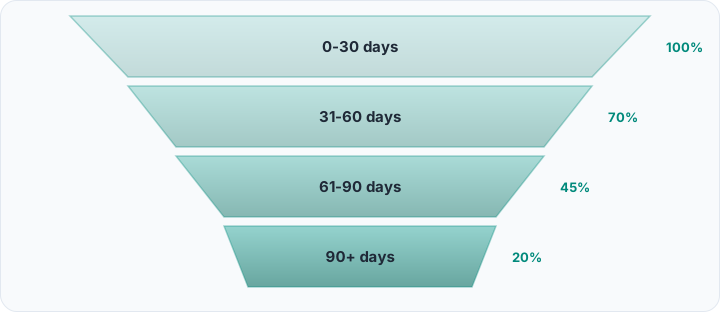
But the stick has a cost too. Apply late fees harshly and you can sour a relationship with a good customer. Most small businesses set this up as a balance: the late-fee clause sits clearly in the contract, but loyal, reliable payers are treated with some flexibility. The rule is written down; how strictly you enforce it depends on the relationship.
When each makes sense — and when it doesn't
Neither tool is right for every business. You can boil the decision down to a few questions.
- Is your margin thin? If you already work on a slim margin, a 2-3% discount can swallow a large part of the profit. In that case it makes more sense to lean on the stick — the late fee — than the carrot.
- Is your need for cash urgent? If you want the money today and alternative financing is expensive, the "interest" you give away as a discount may be reasonable. Discounting early payment simply because cash is plentiful is needless generosity.
- What is your customer profile? Large, corporate customers respond quickly to a discount; with small, irregular payers a clear late-fee policy tends to be more effective.
Honest advice: don't slap both on every invoice blindly. Look at your receivables with an aging report, see where you get stuck most, and pick the tool to match. Sometimes the fix is neither a discount nor a late fee, but simply a shorter term from the start.
Collect your receivables before they fall overdue
Rocketly tracks invoices and due dates on one screen and automates payment reminders.
Explore RocketlyKeep the terms written and clear
Whichever tool you use, both only work if they are written down and agreed in advance. A late-fee line added to the bottom of an invoice after the fact usually produces an argument and an uncollectable debt.
A practical checklist:
- Contract and quote: Write the early-payment discount rate, the payment window, and the late fee that applies on delay right at the start. No surprises.
- On the invoice: State the due date, the discounted amount, and the final payment day clearly on every invoice. Leave no question in the customer's mind.
- Reminders: A gentle nudge a few days before the due date prevents most delays before they form. Most people aren't ill-intentioned, just forgetful.
Recording cash movements and collections regularly matters just as much as setting the rules. A business that keeps up its cash management and reconciliation sees at a glance which invoice is paid and which is late — so it applies the late fee correctly and doesn't accidentally deduct the same discount twice.
VAT and the accounting side
This part is a little technical, but it shouldn't be skipped. Early payment discounts and late fees affect not only your cash flow but the tax side too.
The general logic: a discount lowers the taxable base of the sale, so in most cases the VAT calculated changes accordingly. A late fee, by contrast, is often treated as a separate income item with its own tax consequences. How these are reflected on the invoice varies by country and regulation.
This is exactly why it helps to know which work is yours and which belongs to a specialist. Get clear on the difference between bookkeeping and accounting: you issue the invoice and track collection, but design the tax treatment of discounts and late fees together with your accountant. No figure or method given here is a substitute for professional advice.
Frequently asked questions
How large should an early payment discount be?
There is no single right rate. Use your own cost of cash as the yardstick: a discount is worthwhile if its annualized cost is cheaper than your alternative financing. If your margin is thin, keep the rate small or don't offer one at all.
Will charging late fees drive customers away?
If applied harshly and without warning, yes. But a reasonable late fee, written into the contract from the start, is seen as fair by most customers. Allowing good customers some flexibility beats never setting the rule at all.
Can I use both at the same time?
Yes, and most businesses do: a discount for the early payer, a late fee for the late one. Just make sure both are stated clearly in the contract and on the invoice, so the customer knows what to expect from the start.
Can I handle the tax side myself?
The basic tracking, yes, but the effect of discounts and late fees on the taxable base and VAT depends on regulation. Keep the records yourself, but confirm the treatment with your accountant.
Early payment discounts and late fees are no magic wand; they are two simple levers. Used well, they put your money in the till weeks earlier; used badly, they quietly erode your profit. The trick is to set the number with math rather than emotion, and to write the rule down in advance. In a system like Rocketly that gathers invoices, due dates, and conversations in one place, you see which receivable is due when, automate reminders, and close the gap between "profit on paper" and "money in the bank." But when you make the final call, don't skip putting your own numbers on the table with an accountant.