Working capital management for small businesses
A practical guide to balancing receivables, inventory, and payables so your small business turns profit into cash and stays out of a cash crunch.
On paper, everything looks fine. Sales are decent, the margin is healthy, the income statement is smiling. Then the last week of the month arrives, there is nothing in the account to cover payroll and rent, and you are tapping the overdraft again. If that sounds familiar, the problem probably is not your profit — it is your working capital management.
This article walks through what working capital actually is, its three moving parts — receivables, inventory, and payables — and how balancing them keeps you out of a cash crunch. One note up front: every number here is illustrative. For your own business, talk to your accountant before acting.
What working capital actually is
At its simplest, working capital is the money it takes to run your business day to day. The textbook definition: short-term assets (cash, bank, customer receivables, inventory) minus short-term liabilities (what you owe suppliers and the tax office in the near term). Positive, and you breathe easy. Negative, and you walk a tightrope every month.
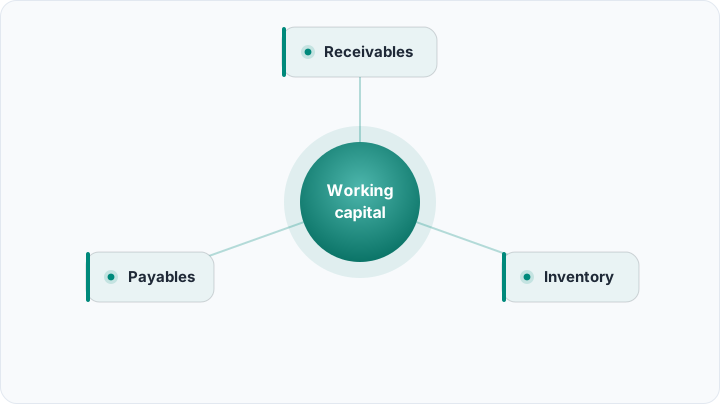
In practice, it is more useful to think in three questions: how much do customers owe you (receivables), how much stock is sitting in the warehouse (inventory), and how much do you owe suppliers (payables)? Add the first two, subtract the third, and you get a rough sense of how much of your money is locked inside the business.
Why does it matter? Because money parked in receivables and inventory is money that is not in your pocket yet. If the shelves are full or your customers pay in ninety days, your income statement can show a profit while your bank account runs dry.
Profit is an opinion; cash is a fact.
The cash conversion cycle: it is all about timing
The best way to grasp working capital is to follow the journey your money takes. First, cash goes out to buy goods or materials. Those goods sit as stock for a while. Then they sell. And often, even after the sale, you do not get paid right away because the customer buys on terms. The stretch between cash leaving and cash coming back is the cash conversion cycle.
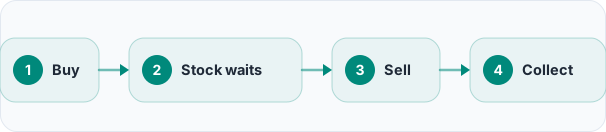
A quick example. Picture a small workshop making hand-poured candles. It pays cash for wax and jars. The finished candles sit on the shelf for roughly 40 days, then sell to a boutique on 30-day terms. So money that left the door takes nearly 70 days to come back — and without capital to fund those 70 days, the workshop can be profitable yet feel perpetually squeezed.
There are three ways to shorten it: collect faster, hold less stock, and stretch supplier terms. We take each lever in turn.
Measuring it: how many days?
You can put rough numbers on the cycle, which makes the problem concrete. Three simple gauges, all in days:
- Days sales outstanding. How long, on average, after a sale do customers actually pay? Invoice on 30-day terms but collect in 50, and that gap is the real number to manage.
- Days inventory outstanding. How long does stock sit before it sells? A cafe's fresh milk turns in days; a furniture shop's sofas may take months.
- Days payables outstanding. How long do you take to pay suppliers? The longer, within reason, the more of their money funds your cycle.
Add them up for the shape of your cycle: receivable days plus inventory days, minus payable days. A shop that collects in 50, holds stock 40, and pays in 30 must self-fund roughly 60 days. You do not need precise figures to start; even rough averages tell you which lever to pull first.
Receivables: do not leave money on the table
A receivable is what a customer owes you — money you have earned but not collected. Offering terms is unavoidable in most B2B trades, but leaving collection to chance is the single most common cash mistake small businesses make.
A few practical moves shorten the cycle noticeably:
- Invoice immediately. Bill the day the work is done; every week you sit on an invoice is a week you have pushed the payment back.
- Spell out the terms. Not “whenever you can” but a concrete “14 days from invoice date,” stated in the agreement so there is nothing to argue about.
- Take a deposit. Asking for an advance before you start production or a custom order shares the risk and the financing burden.
- Systematize follow-up. Send polite, regular reminders for invoices coming due and overdue; shyness about chasing payment is expensive.
One more way to speed collection is to use early-payment discounts and late fees: a small discount for paying early, a fair fee for paying late. And if you sell on terms with post-dated instruments, tracking cheques and promissory notes properly keeps collection day free of surprises.
Inventory: neither tie up cash nor run out
Inventory is the classic case of being caught between two fires. Hold too much and your money sleeps on the shelf — with storage costs, spoilage, and obsolescence on top. Hold too little and you are empty-handed when a customer walks in, handing the sale to a competitor.
Picture a small hardware store: the top 20 fast-movers bring in most of the revenue, while a handful of specialty items gather dust for months. The money tied up in those dead items is exactly that — dead money, sitting in the back room when it could be working elsewhere.
The goal is to find the “enough but not too much” point for each line. A simple inventory management discipline — knowing what turns quickly and what has been static for months — is essential. Turning stagnant stock back into cash, even at a discount, usually beats keeping it in the warehouse.
Payables: use supplier terms wisely
Payables are the flip side: what you owe your suppliers. And here, oddly, time is on your side. Every day of terms a supplier grants you is a day you keep that money working in your business — in effect, free short-term financing.
That is why negotiating terms is fair game. Getting 30 days instead of 15 eases your cash cycle directly. But mind two traps:
- Do not burn the relationship. Squeeze a supplier by paying late again and again, and eventually they will raise the price or pull the terms; short-term relief becomes a long-term cost.
- Do not miss an early-payment discount. Some suppliers offer a discount for paying up front; if that discount beats what the cash earns in your hands, paying early is the smart move.
Seeing clearly who owes you and whom you owe helps both your cash plan and your reporting; the same figures feed a balance sheet and income statement read.
Get your cash under control
Rocketly brings receivables, inventory, and supplier payables onto one screen, from quote to collection.
Try it freeManaging the three levers together
Here is the catch: the three levers are not independent. Pull one and another moves. Squeeze a supplier too hard and you lose the discount. Cut inventory too thin and you lose sales. Force very short terms on a customer and they may walk to a competitor.
So working capital management is not a one-time setting — it is an ongoing balancing act. The good news: in most small businesses even a few weeks of tightening make a real difference — collections pulled forward five days, dead stock cleared, ten extra days won from a supplier. Stack those, and the “end-of-month panic” quietly disappears.
To see the bigger picture of your cash cycle, read this alongside cash flow management; working capital is the most overlooked fuel behind healthy cash flow.
Early warning signs of a cash crunch
A few signals flag a deteriorating working-capital position before a crisis hits:
- The same tension every month-end. If you look profitable but keep drawing on an overdraft to make payroll, your cycle is too long.
- Growing and getting tighter. Cash shrinking while sales rise — the over-trading trap — is a classic sign; every new order eats money as stock and cost before it is collected.
- Full warehouse, empty till. Plenty of assets on the balance sheet but no cash means your money is locked in the wrong place.
So how much working capital do you need? There is no single right number — it shifts with seasonality, sector, and growth. Set your own threshold and plan for seasonal swings with a “safe buffer” conversation with your accountant.
Frequently asked questions
Are working capital and cash flow the same thing?
No, but they are relatives. Working capital is a snapshot at a moment in time: the balance of your receivables, inventory, and payables. Cash flow is the movie of how the money in that balance moves in and out over time. Managing working capital well eases your cash flow.
Is negative working capital always bad?
Not always. Some businesses that sell for cash and pay suppliers on terms — a fast-turning grocery, say — run healthily on negative working capital. But for most small firms that sell on terms, a negative figure is a warning of a coming cash crunch.
Where does the fastest improvement come from?
Usually from receivables. Invoicing on time, clarifying terms, and following up consistently is the quickest and cheapest win for most businesses; inventory and supplier terms tend to be slower to shift.
Should I track all this myself?
You can handle the day-to-day tracking, but for interpreting the numbers correctly and the tax side, an accountant is essential. Every example here is a guide, not advice; make the decisions with your professional.
Working capital management is not a glamorous topic — but it is exactly where most small businesses either sink or stay afloat. The firms that keep receivables, inventory, and payables in steady balance are the ones that actually turn profit into cash. For owners who want to see that balance on a single screen, Rocketly ties quotes, invoices, collections, and stock together so you can spot where your money is locked. The rest is just holding the balance a little better each month.