Time management for sales: spend your hours on what closes deals
Does admin eat your day, do follow-ups get forgotten, and does the inbox run your day? Time management for sales: time traps, prioritisation, time-blocking and how a CRM helps.
For a salesperson, time is the one resource you cannot make more of, and the difference between a great rep and an average one is often not talent but how they spend their hours. A sales day is pulled in many directions: prospecting, following up, meetings, proposals, admin, updating the CRM. Without deliberate time management, the urgent crowds out the important, low-value busywork eats the day, and high-value deals get the leftovers. This article looks at where sales time goes, the common time traps, and how to steer your hours toward what actually closes deals, including how a CRM helps.
Where sales time actually goes
Many salespeople spend a surprisingly small part of their day actually selling; the rest goes to admin, searching for information, entering data and switching context. The trouble is that this work feels necessary, yet much of it can either be eliminated or batched. Without knowing where your hours go, you work harder but not sell more. The first step is to see the low-value patterns that eat most of the time and free that time for selling.
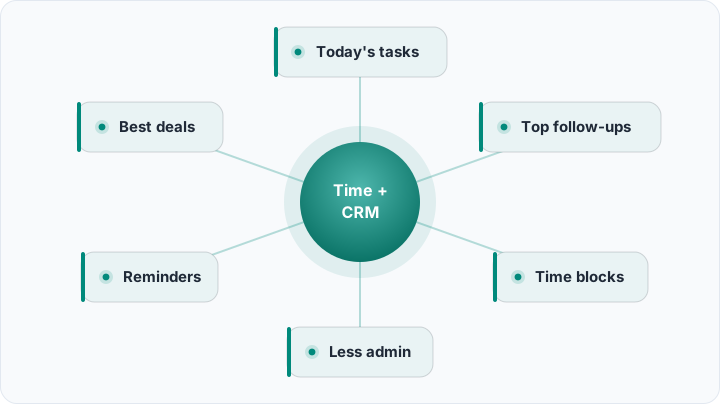
A CRM can be a quiet time-saver here, because by taking over remembering, searching and following up, it frees the salesperson's energy for the real work, talking to people and closing deals. But first it helps to see the common traps.
The common time traps
The same traps recur in rep after rep. Admin overload: spreading notes, emails and updates by hand eats a big slice of the day. Chasing the wrong leads: giving every lead equal time steals time from the most promising ones. Context-switching: constantly jumping between calls, email, meetings and admin fragments focus, and every switch carries a cost. Reacting instead of planning: letting the inbox dictate the day means the loudest work gets ahead of the most important. No prioritisation: without an order of priority, easy tasks get done first and the hard but valuable ones get put off.
Prioritise ruthlessly
Not all leads and deals are equal, so your time should not be spread equally either. Focusing on the highest-value opportunities at the right stage produces far more closed deals from the same hours. This is the heart of sales rep productivity: working smarter, not just harder. Because a CRM makes visible which deals are progressing, which are stuck and which are valuable, it helps you prioritise your day by your actual pipeline rather than by guesswork. Asking each day, "what are the three most important things today?" and doing them first is the simplest yet most powerful change.
Time-block your day
Batching similar work instead of constantly switching tasks protects focus and saves time. Set a block for prospecting, a block for follow-ups, a block for admin, and during that block do only that work. Protected time blocks are especially critical for high-value, easily-postponed work like prospecting and follow-up, because something urgent will otherwise always push them aside. Gathering admin into a set time of day keeps it from leaking in between selling hours. A blocked day is both calmer and more productive than a scattered one.
Make follow-up systematic, not manual
Most deals are won or lost in the follow-up, but follow-up is also the easiest work to forget. Relying on memory or scattered notes means opportunities quietly die. A CRM lets you schedule the next follow-up for every interaction and reminds you when it is due, so no prospect slips through the cracks. This is the foundation of a sales follow-up strategy: follow-up becomes a systematic process, not an intention. When follow-ups are systematic, you do not spend mental energy remembering each one and none are forgotten, which wins both time and closed deals.
Cut the admin: let the CRM do the remembering
Data entry and searching for information are most salespeople's biggest time leak. Logging every email by hand, hunting for each customer detail in different places, and making every update manually eats hours. A CRM reduces this burden: information lives in one place, most updates are automated, and you open and see rather than search. This is the subject of reducing CRM data entry, and it translates directly into time: every minute spent on admin is a minute that could be spent selling. The aim is to turn the salesperson back from a data-entry operator into a salesperson.
Let the CRM surface what matters today
A salesperson should not have to start the day from scratch. A well-set-up CRM puts today's tasks, overdue follow-ups and the deals that need attention in front of you, so instead of remembering what matters you simply do it. This is a practical benefit of the principle that underpins any CRM; our guide to what a CRM is explains that foundation. Running your day from a system-prioritised list rather than a to-do list both reduces the mental load and ensures nothing important slips.
Manage your energy, not just the clock
Time-blocking handles your hours, but two hours are not equal: the same task is easy when you are fresh and a slog when you are drained. Demanding sales work, important calls, tough negotiations, writing a careful proposal, deserves your peak hours, usually the morning for most people, while routine work like logging activity, light admin and easy follow-ups can go in the lower-energy stretches of the afternoon. Matching the task to your energy gets more out of the same day than willpower ever will, because you stop spending your sharpest hours on work that any time could handle. It also protects you from burnout, which is itself a hidden time-killer: a rep running on empty makes worse decisions, writes weaker follow-ups and avoids the hard calls that actually move deals. Guard your peak hours for the work that wins business, take real breaks so your energy recovers, and treat your attention as the scarce resource it is. Managing energy alongside time is what lets a good routine hold up week after week instead of collapsing the moment things get busy.
Review your week to keep improving
Time management is not a one-time setup but a habit that improves with a short, regular review. Once a week, look back: what got done, what stalled, where the hours actually went, and which deals moved. A CRM makes this honest rather than guesswork, because its activity history shows the real picture, how many follow-ups you completed, which deals advanced a stage, where things sat untouched. That review answers the questions that matter: are you spending time on your most valuable deals or being pulled toward easy busywork, and is anything quietly slipping? With the pattern in front of you, you can adjust the next week deliberately, protect a block that keeps getting eaten, drop a low-value habit, or chase a stalled deal you had lost sight of. A few minutes of review turns vague effort into a feedback loop, and small weekly adjustments compound over months into a markedly more productive way of working. Without it, the same time traps quietly repeat; with it, every week is a chance to get a little sharper.
A simple daily routine
A simple routine that brings all of this together might look like this. Morning: open the CRM, review today's follow-ups and tasks, and decide the three most important things for the day. Rest of the morning: while your mind is freshest, do the highest-value work, important calls, follow-ups, proposals, in a protected block. Afternoon: set a block for meetings and more routine follow-ups. A set time of day: gather all admin and CRM updates into one block, so they do not leak through the day. End of day: take five minutes to quickly review the next day's follow-ups, so you start tomorrow ready. This routine does not have to be perfect; it just has to put you, not the inbox, in charge of the day.
How Rocketly helps
Rocketly is built to protect a salesperson's time. It puts today's tasks and priority follow-ups in front of you, so you do not plan the day by guesswork; reminders mean no follow-up slips; and by reducing admin it lets you see information in one place rather than search for it. Because everything lives in one place, your day goes to selling rather than to switching between scattered tools. To understand the foundation this all rests on, start with our guide to what a CRM is.
Conclusion
In sales, time is the scarcest resource, and how you spend it often decides how much you sell. Admin overload, chasing the wrong leads and an unprioritised day quietly eat the hours; ruthless prioritisation, time blocks, systematic follow-up and cutting admin win them back. A CRM makes this approach possible by putting what matters today in front of you, remembering follow-ups and reducing data entry, steering your hours toward what actually closes deals. Start tomorrow by opening your CRM and deciding the three most important things for the day, and build from there.
Spend your hours on what closes deals
Rocketly puts today's tasks and priority follow-ups in front of you and cuts the admin, so your time goes to your best deals. No credit card required.
Start Free