Types of CRM: what are operational, analytical and collaborative CRM?
What are the types of CRM: what operational (automation), analytical (data and insight) and collaborative (cross-team sharing) CRM are, real examples, when each matters, the cloud vs on-premise distinction and how to evaluate type when choosing.
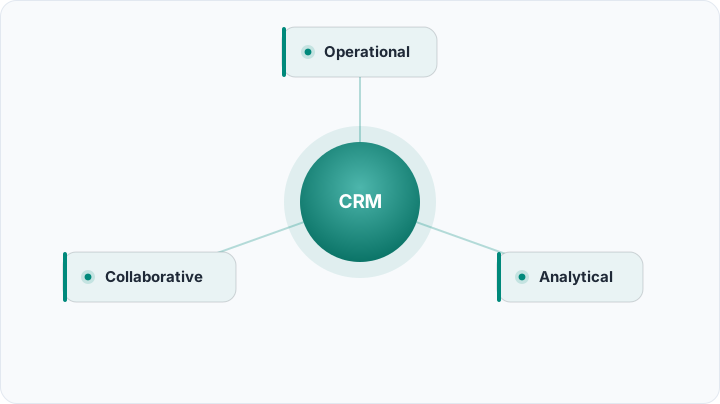
Not all CRMs do the same job. Under the heading "CRM" there are three core approaches, each serving a different priority: operational, analytical and collaborative. When you're choosing a CRM, or trying to use the one you have better, knowing these three types clarifies your path, because each focuses on a different problem. The operational kind automates daily work, the analytical kind makes sense of data, and the collaborative kind brings teams together around the same customer.
An important note: these three types are often not separate products. Most modern CRMs offer all three together; the distinction is more a useful framework for understanding what job a CRM serves. Still, knowing the difference helps you choose the tool that best fits your need and use all the facets of the tool you already have. In this guide we cover the three types one by one, with real examples and when each matters.
Why does knowing the CRM types matter?
Most businesses see a CRM as "the place where contacts and deals are stored" and use only a small part of its potential. But what a CRM can give you depends on which type is strong. If your need is to reduce repetitive work, operational capabilities matter; if you want to make decisions with data, the analytical side comes to the fore; if your teams touch the same customer in scattered ways, the collaborative aspect becomes critical. Knowing the types lets you both choose the right tool and get the full return on your investment. The what is a CRM article explains the basic concept; this one opens up the different faces of that concept.
1) Operational CRM
Operational CRM focuses on automating daily sales, marketing and customer-service processes. Its goal is to remove repetitive manual work so your team's time goes to the truly valuable work — taking care of the customer. Automatic assignment when a lead arrives, automatic task creation when a stage changes, follow-up emails going out on time: these are all the work of operational CRM. Managing the pipeline, tracking tasks and standardising processes also fall under this type. To go deeper into this automation, see CRM workflow automation.
2) Analytical CRM
Analytical CRM focuses on turning accumulated customer data into meaningful insight. It reveals which sources bring the best customers, which products sell together, and which customers are at risk of being lost. Reports, segmentation, sales forecasting and performance dashboards are the tools of analytical CRM. Set up well, it lets you decide with evidence rather than intuition. To read reports correctly, CRM report literacy helps; to measure the return on your investment, how to calculate CRM ROI guides you; and you can find how AI takes this analysis further in AI in CRM.
3) Collaborative CRM
Collaborative (or strategic) CRM focuses on sharing customer information across teams and channels. Its goal is to make sure sales, marketing and support teams see the same information about the same customer; so the customer doesn't have to explain from scratch at every contact. When a message from WhatsApp, a request by email and a call on the phone all come together in a single record, everyone sees the whole picture. The foundation for building this unified view is the multichannel communication approach.
All three together: the modern CRM
In reality these three types aren't separated by sharp lines; a good modern CRM offers all three together. The operational side runs the work, the analytical side learns from that work, and the collaborative side carries what's learned to everyone. For example, a sales automation (operational) produces data, that data feeds a forecasting model (analytical), and the result appears on a dashboard the whole team sees (collaborative). That's why the modern answer to "which type should I choose?" is usually "one that does all three well."
Which type stands out for you?
Your need changes with your business's situation. If you're a small, new team, your priority is usually operational: getting work in order, missing no lead. As you grow and data accumulates, the analytical side gains value: measuring what works. When several teams start touching the same customer, the collaborative aspect becomes critical. In practice most businesses need all three; the difference is which one you start with. We covered the right start for small teams in the best CRM for small business.
Another distinction: cloud or on-premise?
Alongside the types, there's also a distinction by where a CRM runs. Cloud-based CRMs are accessed over the internet, require no installation or maintenance, work from anywhere and are paid by subscription — the most common choice for small and mid-size businesses. On-premise CRMs are hosted on your own servers; they offer more control but bring the burden of setup, maintenance and cost. This distinction is independent of "type": operational, analytical and collaborative capabilities can be found both in the cloud and on-premise.
How do you evaluate type when choosing a CRM?
When evaluating a CRM, ask "which type is this tool strong in?" and match that to your own priority. A tool with very powerful reports but weak daily automation may not suit you if your real need is to get work in order. Conversely, a tool with excellent automation that can't make sense of data may leave you blind as you grow. You can find the steps of the right evaluation in the CRM selection guide, and the ways to fit the tool to your own process in CRM customization.
Common misconceptions
Avoid these misconceptions: thinking "a CRM is a single type of software" (it isn't — it has different strengths); focusing only on one type (usually operational) and ignoring the others; investing in an expensive, complex analytical tool without even getting basic operations in place; and trying to build the three types with separate tools that don't talk to each other. The real power is in the three combining in a single system and working around the same customer.
What does each type measure?
The three types count different things as success, so the metrics each watches differ too. In operational CRM, success is efficiency: response time, task-completion rate, the length of the sales cycle, the number of automated steps. In analytical CRM, success is the accuracy of insight: conversion rates, forecast accuracy, customer lifetime value, revenue per segment. In collaborative CRM, success is seamlessness: resolution time, the number of cross-team handoffs, customer satisfaction, first-contact resolution rate. You can tell which type you've invested in by which metrics you track.
CRM types and your industry
Which type stands out also depends on your industry. High-transaction e-commerce and retail benefit most from strong operational automation. Finance, insurance and subscription businesses, where data-driven decisions are critical, bring analytical capabilities to the fore. Consultancies, agencies and B2B sales, where several teams touch the same customer, make the collaborative aspect essential. Still, this isn't an "either/or" choice; your industry tells you which type to start with, but as you grow most businesses lean into all three.
Example: a business using all three types together
Picture a mid-size service company. A customer fills out a form on the website; the operational CRM automatically assigns it to a sales rep and creates the first follow-up task. The rep logs the call, the deal progresses. At month's end the manager sees on the analytical CRM's dashboard which source earned the most and at which stage deals get stuck. Meanwhile the support team, because it can see the same customer's past sales conversations through the collaborative view, solves the issue without making them explain from the start. All three types work in the same record; the result is far more than a single tool could do.
Bring all three types together in one place
A good CRM automates operations, turns data into analysis and unites the team around a single customer view — all in the same place. Rocketly offers these three on one platform; your team does the work, the system learns, and everyone stays on the same page. Try it on the free plan, no credit card required.
Start FreeSummary
A CRM splits into three core types: operational, which automates daily work; analytical, which turns data into insight; and collaborative, which brings teams together in a single customer view. These aren't separate products but different faces of a CRM; modern systems combine all three. There's also a deployment distinction between cloud and on-premise. The right choice comes from matching which type you need a strong tool in to your priority — and for most businesses, the best is a CRM that does all three well in one place.