CRM for driving schools: enrollment, reminders and payment tracking
Do inquiries slip, lessons and exams get forgotten, and installments go untracked? A CRM for driving schools unifies the enrollment pipeline, lesson/exam reminders, progress and payments.
A driving school's business is a steady cycle: turn inquiries into enrolled students, schedule and remind them through a series of lessons and exams, collect payments (often in installments), and get them to their licence, all while filling the next cohort. The recurring challenges are clear: converting people who are shopping around, no-shows for lesson and exam appointments, tracking where each student is in their lesson and exam progress, and collecting payments. Many schools run all of this on a paper schedule, the phone and memory, and that leaks enrollments, causes no-shows, loses track of student progress, and lets payments slip. A CRM gives the school one system for inquiries, students, lesson and exam reminders, progress and payment status. This guide explains what a CRM does for a driving school, where it protects the most time and money, and where its limits are.
Why schools lose time and money without a system
Without a central system, the same problems recur in school after school. Un-followed-up inquiries: someone asks about prices, but if no one responds in time, they enroll at another school. No-shows: when a student misses a lesson or exam appointment, instructor time is wasted, and instructor time is a school's real inventory. Losing track of progress: tracking which student has taken how many lessons and who is ready for the exam is hard on paper, and students fall through the gaps. Missed payments: when payments are taken in installments, tracking who has paid what by hand is error-prone and balances get forgotten.
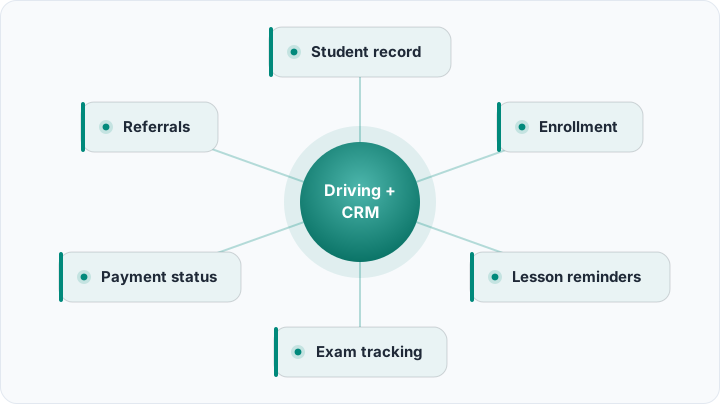
The common thread is that the school's student relationship is spread across paper, the phone and memory rather than held in one reliable place. A CRM addresses this by becoming the single record of every student, inquiry, lesson, exam and payment, so no inquiry, no appointment and no payment slips through the cracks.
Turn inquiries into enrollments
People choosing a driving school usually compare a few, so fast, organised follow-up wins enrollments. A CRM turns every inquiry into a tracked record that moves through clear stages: inquiry received, information given, enrolled. So no prospect goes unanswered, every inquiry is followed up in time, and the school can see how much interest actually turns into an enrollment. This is lead management applied to a driving school: inquiries are not just taken but routed through to enrollment. The school that calls first and gives clear information is often the one that wins the enrollment; those that handle inquiries loosely lose the interest they already created to a competitor.
Cut lesson and exam no-shows
For a school, the biggest operational win is reducing the rate of missed lessons and exams. An empty lesson slot is instructor time that can never be recovered, and a missed exam appointment delays the student. A CRM can send automatic reminders before every lesson and exam, so students do not forget and, even if they do, hear in time to rebook. This is the very heart of appointment and reminder automation: instead of reception calling each student one by one, the system sends the reminders itself. Even cutting no-shows by a few points means directly recovered instructor time and students who progress faster.
Track each student's progress
A driving school moves every student through a series of steps: theory lessons, driving lessons, exam attempts. A CRM makes visible where each student is on this journey on one record, how many lessons are completed, when the exam is, which step is outstanding. Without this visibility, staff have to reconstruct each student's status from paper or memory, and some students get stuck at a step. With it, the school moves every student systematically toward their licence and spots anyone who has stalled, gently nudging them to the next step.
Payment and installment tracking
Driving schools often take payments in installments, so tracking who has paid what matters. A CRM can make each student's payment status visible on their record, what has been paid and what is pending, so balances are not forgotten and a gentle reminder can go out in time for late ones. This ties into the broader idea of payment integration with the CRM: payment status lives on the same record as everything else about the student, so staff see the financial picture alongside progress and communication. Tracking payments systematically protects the revenue most schools quietly leak.
One student record and communication
Underneath all of this is a single student record. Instead of reconstructing a student's situation from paper and memory every time, anyone authorised at the school can open one record and see who the student is, their progress, their payments, the history of communication and what is outstanding. This makes students feel recognised at every contact and lets staff serve from an accurate picture. This shared record is the same principle that underpins any CRM, the idea explained in our guide to what a CRM is.
Re-engaging students who stalled
Driving schools have a particular kind of quiet loss: students who enrolled, took a few lessons, and then simply stopped, without finishing, without sitting the exam, sometimes with lessons still paid for. Life gets busy, confidence dips, an exam date slips, and the student drifts away unnoticed. On a paper schedule these students are effectively invisible, because nothing flags that someone who was coming weekly has not booked a lesson in two months. A CRM makes them visible. Because each student's progress and last activity sit on their record, the school can identify everyone who has stalled partway through and reach out deliberately: a friendly check-in asking how they are getting on and inviting them to book their next lesson or exam. Many simply needed a nudge, and a meaningful share will come back and finish. Re-engaging a stalled student is far cheaper than winning a new one, the relationship and often the payment already exist, and helping them reach their licence is good for the student and for the school's reputation alike.
Referrals and reviews
Much of a driving school's new business comes from word of mouth and online reviews; a happy student who passes recommends the school to friends and family. A CRM can help reach out to a newly licensed student at the right time to leave a review, and track referrals back to their source. Systematically asking happy students for reviews and referrals turns a growth source most schools leave to chance into a regular channel.
A concrete example
Picture a school that kept its schedule on paper and inquiries in a notebook by the phone. Some inquiries went un-returned on busy days and prospects went to another school; instructor hours were wasted because students forgot lesson and exam appointments; it was unclear where some students had stalled; and some installments were forgotten. After adopting a CRM, every inquiry becomes a tracked record with a clear next step and none are dropped. Every lesson and exam gets an automatic reminder and the no-show rate falls noticeably. Each student's progress and payment status sit on one record, so no one gets stuck and no balance is forgotten. A year on, the school sees a fuller schedule, students reaching their licence faster, and fewer missed payments, without adding staff.
What a CRM is, and isn't, for a driving school
It is worth being clear about scope. A CRM excels at the relationship and business side of a school: inquiries, enrollment, lesson and exam reminders, progress visibility, payment status and referrals. It does not, by itself, replace official exam-booking systems or regulatory reporting tools; the school continues to use the relevant official systems for those, and the CRM works alongside them. The honest way to think about a CRM is as the connective layer that fills the school's schedule, moves students toward their licence, and never drops an inquiry or a payment.
How Rocketly fits a driving school
Rocketly gives a school one place for its student relationships and the work of keeping the schedule full. Each student can have a single record with their progress, payments and history; inquiries can flow through an enrollment pipeline; lesson and exam reminders can go out automatically; and payment status can be visible. Because everything lives on one record and one timeline, anyone authorised sees the full picture. To understand the foundation this all rests on, start with our guide to what a CRM is.
Conclusion
A driving school lives on a full schedule and students who reach their licence, and managing this from paper and memory leaks time and money. A CRM gives the school a pipeline that converts more inquiries into enrollments, lesson and exam reminders that protect instructor time, progress tracking that shows where everyone is, and payment visibility that forgets no balance, all on a single record for each student. Used for what it does best, it lets a school keep a fuller schedule, move students faster and lose fewer payments without growing its admin burden. Start by automating lesson and exam reminders and tracking each student's progress and payment status in one system, and build from there.
Keep the wheel full and students on the road
Rocketly brings enrollment inquiries, lesson and exam reminders, progress and payments into one place, so no-shows drop and students reach their licence. No credit card required.
Start Free