How to build a sales playbook: turning tribal knowledge into a shared standard
What is a sales playbook and how do you build one? Mapping the process, gathering best practices, messaging and objection responses, connecting to CRM stages, and keeping a living document.
In many sales teams, the knowledge of "how we sell" lives in the heads of the best reps. When that person leaves, the knowledge goes with them. When a new rep joins, they rediscover everything from scratch. A sales playbook solves exactly this: a documented, repeatable guide to how your team sells — the process, messaging, objection responses, tools. In this piece we cover how to build a sales playbook.
The goal is to turn sales knowledge from being trapped in the intuition of a few star reps into a shared standard the whole team can apply — and to build it not as a file no one reads but as a living, genuinely used system.
What is a sales playbook?
A sales playbook is a guide that documents how your team sells: the stages of the sales process, what to do at each stage, which messages to deliver, how to respond to common objections, how to qualify an opportunity, and which tools/templates to use. In short, the playbook turns "tribal knowledge" — the experience scattered in people's heads — into a shared, written standard. Like a sports team's playbook: an agreed-upon plan everyone knows for how the team will play.
Why do you need a playbook?
A playbook provides a few concrete benefits. Consistency: Everyone sells the "good" way, the best rep's approach becomes the standard. Faster onboarding: A new rep starts with a ready guide instead of discovering everything from scratch — this markedly shortens the ramp time. Captured best practices: Methods that work aren't lost but recorded. Scalability: As the team grows, the playbook keeps everyone at the same standard. Without a playbook, each rep invents their own method and knowledge drifts as people come and go.
Playbook vs enablement vs onboarding
These three concepts get confused but are different. The playbook is the concrete guide documenting "how we sell." Sales enablement is the broader function that provides everything needed to make reps successful (training, content, tools, including the playbook). Onboarding is the process of getting a new rep ready. So the playbook is a part of enablement and a tool of onboarding. The playbook says "what to do"; enablement builds the system that makes it possible. The two complement each other.
The playbook-building process

Building a playbook follows a clear process. First you map your sales process: what the stages are, how an opportunity advances. Then you gather best practices: what do your best reps actually do? Then you document these: turn them into a clear, usable guide. Then you embed the playbook in the team: bury it inside the workflow. And most importantly, you measure and update: improve the playbook as you learn what works. This process turns the playbook from a one-time document into an ongoing discipline.
Start by mapping the process
A playbook isn't a free-floating "best practices" list — it's built on top of your real sales process. So the first step is clarifying your sales process and its stages: how a lead turns into an opportunity, which stages it passes through, what should happen at each stage? Mapping the sales process forms the skeleton of the playbook — because the playbook explains "what to do" at each stage of this process. A playbook written without clarifying the process is like a building without a foundation; you need to know the flow first, then guide that flow.
Gather best practices
The playbook's content shouldn't be made up — it should come from what your best reps actually do. What questions do they ask, how do they handle objections, how do they close a deal? The best way to find these patterns is examining real conversations and won deals. As with coaching based on conversation data, mining the real behavior of top performers gives the playbook concrete and proven content. The goal is to document not "what you think should be" but "what actually works" — because the playbook's value comes from capturing real success.
What's in the playbook?
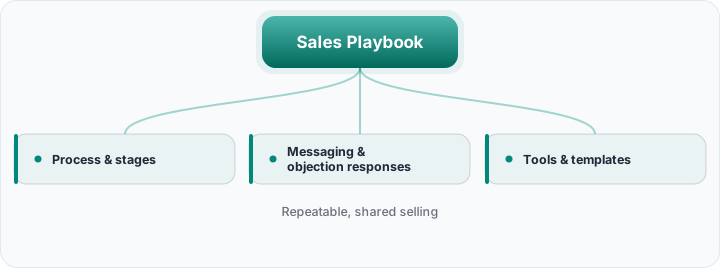
A good playbook contains a few basic components. Process and stages: the stages of your pipeline and what to do at each. Qualification criteria: how you tell whether an opportunity is good (ideal customer profile, qualification questions). Messaging: value messages suited to each customer type/stage. Objection responses: tried, working responses to common objections. Tools and templates: email templates, presentation, quote formats. When these components come together, the playbook offers a rep a ready answer to the "what should I do in each situation?" question.
Messaging and objection responses
One of the most valuable parts of the playbook is messaging and objection responses. Which value message you deliver to each customer type and how you respond to common objections (price, timing, competitor) are the conversations at the heart of the sale. Documenting the approaches your best reps use in these conversations lets the whole team speak with the same mastery. For example, which questions to ask in the discovery stage — with a framework like the SPIN technique — is in the playbook. So even a new rep accesses the conversation patterns an experienced person learned over years from day one.
Tools, templates, and CRM stages
A playbook shouldn't stay abstract — it should connect to concrete tools and CRM stages. Which email template to use at each sales stage, which presentation to give, how to prepare the quote should be clear in the playbook. And most importantly, this playbook should match your CRM's stages: your CRM pipeline templates are where the playbook lives. Guidance on "what to do here" at each CRM stage makes the playbook a part of daily work. So the playbook becomes not a theory forgotten in a separate file but a roadmap the rep follows on every opportunity.
Embedding the playbook in the team
A playbook no one reads is useless. The most common mistake is preparing a nice document, putting it in a folder, and forgetting it. The playbook's value emerges only when it's buried inside the workflow: it should be taught as part of onboarding, referenced in coaching, and most importantly live inside the CRM — as guidance at each stage. If a rep has to go to a separate place to reach the playbook, that playbook won't be used. But if the playbook is inside the system the rep already uses (the CRM), it naturally becomes part of the work. Embedding turns the playbook from a document into a behavior.
A living document: measure and update
A playbook isn't carved in stone — because sales constantly changes. The market changes, the product evolves, new objections arise, new methods work. So you need to review and update the playbook regularly: as you learn what works, you improve the playbook. For example, if an objection response no longer works, you change it; if a new successful approach is discovered, you add it. A static, un-updated playbook goes stale over time and gets ignored. A living playbook, on the other hand, becomes the team's continuously learning collective memory — one everyone contributes to and everyone benefits from.
Make your playbook a living system, not a document
Rocketly embeds your sales process's stages, the templates at each step, and the to-dos inside the CRM; your playbook becomes not a file no one reads but a flow the team uses every day.
Start FreeCommon mistakes
- Writing without mapping the process: A playbook that doesn't sit on the real sales process is a building without a foundation.
- Putting in made-up content: Not "what you think should be" but what the best actually do should be documented.
- Putting it in a folder and forgetting: A playbook not buried in the workflow is read by no one.
- Keeping it disconnected from the CRM: If the playbook doesn't connect to CRM stages, it doesn't become part of daily work.
- Leaving it static: An un-updated playbook goes stale over time and gets ignored.
- Confusing it with enablement/onboarding: The playbook is a document; enablement is the system that makes it possible — know the difference.
Getting-started checklist
- 1. Map your sales process. Stages and what happens at each are the playbook's skeleton.
- 2. Gather the best's real practices. Mine from won deals and conversations.
- 3. Document the basic components. Process, qualification, messaging, objection responses, tools.
- 4. Connect to CRM stages. Have "what to do" guidance at each pipeline stage.
- 5. Embed in the workflow. Keep it live inside onboarding, coaching, and the CRM.
- 6. Measure and update. Improve the playbook as you learn what works.
Frequently asked questions
Does a small team need a sales playbook?
Yes — in fact, a playbook can be even more valuable for a small team, because knowledge concentrates in a few people's heads and a big gap forms when those people leave. In a small team the playbook doesn't have to be complex; even a few-page guide documenting the process and basic approaches makes a big difference. A playbook arises less from team size than from the need to make knowledge person-independent and repeatable.
Who should prepare the playbook?
A playbook isn't something a single person writes at a desk — it should come from the real experience of the best reps. Ideally, the sales leader manages the process but gathers the content from the team's top performers: their real conversations, objection responses, and winning methods. This collaborative approach makes the playbook both realistic and a document adopted by the team; a guide distilled from the best's knowledge, not imposed from the top.
How detailed should the playbook be?
Detailed enough but concise enough not to be overwhelming. A too-short playbook can't guide; a too-long and complex playbook won't be read or used. The goal is to be concrete enough that a rep can find a practical answer to the "what should I do in each situation?" question, but flexible enough not to make a rule of every detail. To start, documenting the process's main stages and the most critical conversations (qualification, objection), then enriching with experience, is a good approach.
Does a playbook restrict reps' creativity?
A well-designed playbook doesn't restrict but empowers. The playbook is a "guide," not a "script": it offers proven approaches but leaves the rep room to adapt to the situation. The goal isn't to turn everyone into a robot but to ensure everyone starts from best practices — so the rep adds their own mastery on top of a proven ground instead of inventing basic conversations from scratch. A good playbook doesn't stifle creativity; it gives it a solid starting point.
A sales playbook is a fundamental productivity tool that takes your team's sales knowledge out of a few people's heads and turns it into a shared, repeatable standard. Its secret lies in building it on top of your real sales process, distilling it from the best's real practices, and — most importantly — embedding it inside the CRM and the workflow instead of forgetting it in a folder. A living, regularly updated playbook becomes your team's continuously learning collective memory: a system that makes new reps productive fast, keeps everyone at the same mastery, and makes your business scalable as it grows.