Team collaboration with a CRM: shared visibility, clean handoffs, clear ownership
Do two reps work the same lead, handoffs lose context, and ownership stay unclear? Team collaboration with a CRM: shared visibility, clean handoffs, clear ownership and avoiding overlap.
Selling and serving customers is rarely a solo act: leads get passed between people, a deal is touched by several hands, a customer knows three people at your company. Without a shared system, that teamwork breaks down: two reps unknowingly work the same lead, a handoff drops context, no one is sure who owns what, and when someone is out their deals go dark. A CRM is the shared backbone that lets a team work as one. This article covers how a CRM enables team collaboration, shared visibility, clean handoffs, clear ownership, avoiding overlap, and why it matters even for small teams. To ground the basics, our guide to what a CRM is explains the underlying idea.
Shared visibility: one record everyone sees
The foundation of team collaboration is everyone seeing the same customer record. When a customer's history, conversations, open issues and status live in one place, anyone on the team can see the whole picture without having to ask "who talked to them last?" This removes friction and gives the customer a consistent experience; whoever they reach knows the context. Without shared visibility, information is trapped in people's heads and inboxes, and the team becomes a set of isolated silos, each on its own island. A CRM tears down those silos: information belongs to the shared record, not to a person, so the relationship continues seamlessly even when one person is away. This single, shared record is the very principle that underpins any CRM, and the foundation on which all team collaboration is built.
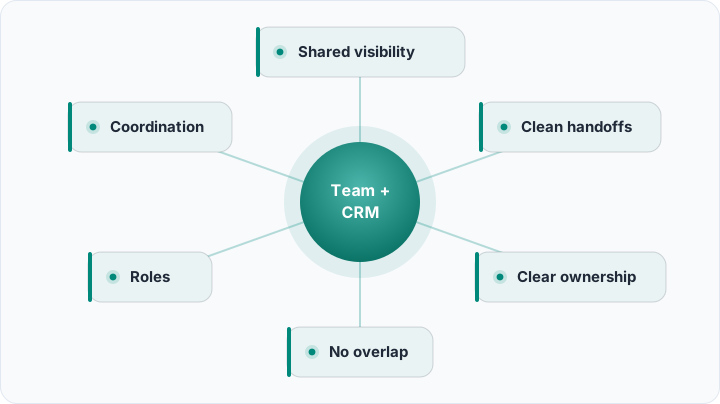
This shared foundation makes everything below possible: clean handoffs, clear ownership and a team free of collisions. All of it starts with everyone seeing the same truth.
Clean handoffs without losing context
Customers are constantly passed between people: sales closes a deal and hands off to customer success, a rep goes on leave and another takes over their deals, a support issue is escalated to a specialist. Each of these handoffs is a risk if context is lost. In a CRM the handoff is clean, because the record carries the full context: the new person takes over seeing the history, the conversations and what is outstanding, rather than starting from scratch. Instead of a hurried email or a half-finished verbal briefing, a complete picture is handed over. This makes the customer feel seamlessly served, they do not have to re-explain themselves, and ensures nothing drops during the handoff. Well-managed handoffs are what keep relationships from being damaged as the team grows or people change.
Clear ownership and accountability
Collaboration does not mean everyone is responsible for everything; on the contrary, it requires clear ownership. When every deal and account has an owner, when it is clear who is responsible for moving it forward, nothing falls into the "I thought you had it" gap. A CRM makes ownership visible and assigned, so everyone knows what is their responsibility and what is someone else's. This both clarifies accountability and makes collaboration easier, because even when helping a colleague it is clear who actually owns the work. In a team where ownership is unclear, either everyone assumes a task belongs to someone else and no one does it, or two people both do it; clear ownership prevents both. Visible ownership is the precondition for a team genuinely working together.
Avoiding overlap and collisions
Without a shared system, two reps working the same lead is a common and costly mistake: effort is wasted, and worse, it looks unprofessional when the customer is contacted by two different people from the same company. A CRM prevents this collision, because it shows who is assigned to a lead and who is already working it. This is a team benefit of lead management: leads are clearly assigned and visible, so no one accidentally dives into an opportunity someone else is working. Avoiding overlap is not only about efficiency; it is about giving the customer an organised, coordinated experience. A team that looks scattered internally looks scattered from the outside too, and that erodes trust.
Roles and permissions: who sees and does what
Collaboration should not mean everyone can edit everything; a good team setup balances visibility with control. Roles and permissions determine who can see and change what: a sales rep can manage their own deals, a manager can see the whole pipeline, and sensitive settings can be open only to certain people. This is the subject of CRM roles and permissions (RBAC). Well-defined roles protect collaboration from chaos: everyone sees the context they need, but no one can accidentally break someone else's work or access something they should not. Roles are what make shared visibility safe and orderly; they provide the balance between openness and appropriate control.
Collaboration for small teams
Some think collaboration tools are only for big organisations, but small teams are often the ones that benefit most. If you are three people and everyone wears many hats, shared context is what prevents dropped balls: one person talks to a customer, another follows up, and a third sends the invoice, all because they see the same record. This is the subject of CRM for small teams. In a small team a single dropped ball is a proportionally bigger blow, so coordination is even more critical than it is in a large team. A CRM lets a small team look coordinated and professional far beyond its size, without complex processes or a crowd.
Faster onboarding and no knowledge that walks out the door
Two of the quietest costs in any team are the time it takes a new hire to become productive and the knowledge that leaves with every departure. Both are really the same problem: when customer history and context live in people's heads rather than a shared system, a new salesperson has to absorb months of tribal knowledge before they can be trusted with an account, and when an experienced rep leaves, much of what they knew leaves with them. A CRM addresses both at once. A new team member can read the full history of any account, the past conversations, the open issues, the preferences, the commitments made, and get up to speed in days rather than months, because the context is written down where they can find it instead of locked in a colleague's memory. And when someone moves on, their accounts do not become mysteries that the next person has to reconstruct from scattered emails; the relationship continues because it never depended on one person's memory in the first place. For a growing team this compounds over time: every interaction logged today is institutional knowledge that makes the next hire faster and the business more resilient to turnover. It also makes delegation and holiday cover painless, because anyone can step into an account and immediately see where things stand. A team that keeps its knowledge in a shared system is one that does not have to relearn its own customers every time the roster changes, and that steady continuity is itself a competitive advantage.
Coordinating without endless meetings
One of the most frustrating ways for a team to coordinate is having status shared only in meetings. A CRM makes coordination asynchronous: because the status of every deal and account is already visible, there is no need for a status meeting to learn where everyone is. A manager can look at the pipeline and see what is progressing; a colleague can open a record and read what last happened; and through notes and mentions, people can pass information to each other without losing context. This does not eliminate meetings entirely, but it makes the ones held just for status updates unnecessary and lets the team spend its time on real work rather than on reporting. Visible status is the best meeting agenda, because everyone is already looking at the same picture.
How Rocketly helps
Rocketly is built for a team to work as one. It puts every customer on one shared record everyone sees; handoffs carry the full context; ownership is clear and assigned; collisions become visible; and roles balance visibility with appropriate control. Because everything lives in one shared picture, the team coordinates without endless meetings or scattered tools. To understand the foundation this all rests on, start with our guide to what a CRM is.
Conclusion
Sales and customer service are a team effort, and without a shared system that teamwork breaks down: overlapping effort, dropped handoffs and unclear ownership. A CRM is the shared backbone that lets a team work as one, one record everyone sees, handoffs that keep their context, clear ownership, collision-free coordination, and roles that make visibility safe. This matters as much for small teams as for large organisations, perhaps even more. Start by putting your next customer on one shared record and assigning every deal a clear owner, and build from there.
Keep your team on the same page with one shared picture
Rocketly brings every customer onto one shared record, so everyone sees the same picture, handoffs keep their context, and nothing falls through the cracks. No credit card required.
Start Free